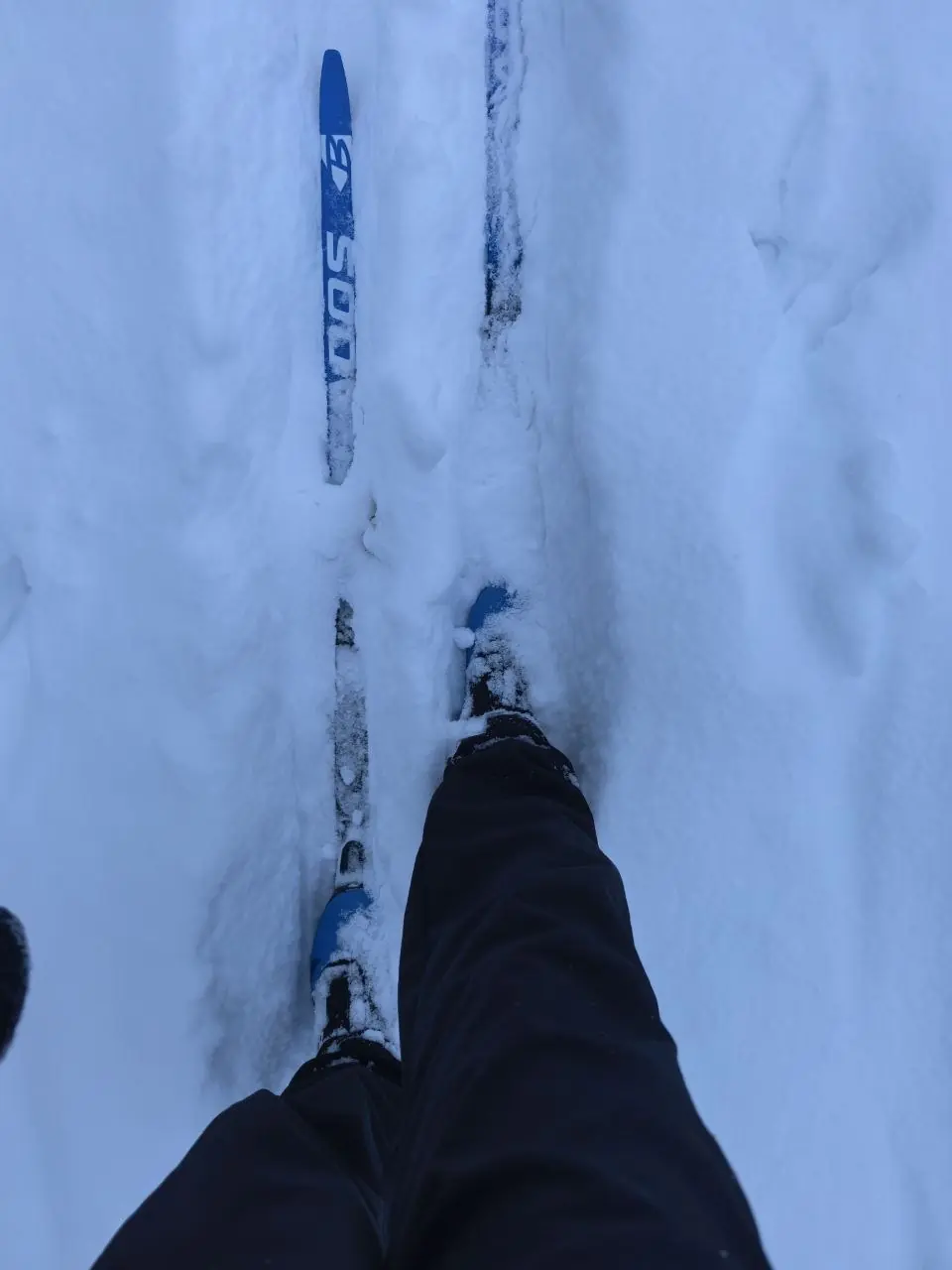
Ivanovskaya station is the gateway into a ski labyrinth. This is not a trail leading from point A to point B, but a network of ski tracks linking dozens of garden communities to one another: squares, zigzags, crossings, passages between plots. The layout of the labyrinth is square, and a power transmission line runs through its centre — the main ski track follows it. It also serves as a landmark: it is easier to get lost among the squares than it seems, and under the power line there is always an open corridor.
This is not a sports venue. It is a recreational ski track: it is groomed, but the width varies, and in places it is narrow and crooked. The average speed of a relaxed pace is about 6 km/h. There are almost no people: one skier every ten minutes, and that is a normal density for a weekday.
The most convenient way in is from Ivanovskaya: the platform stands almost in the forest, you do not need to walk around the village — you step off and are straight onto the ski track. You can also start from other stations on this line (Gory, Mga), but the walk from there to the labyrinth is longer.
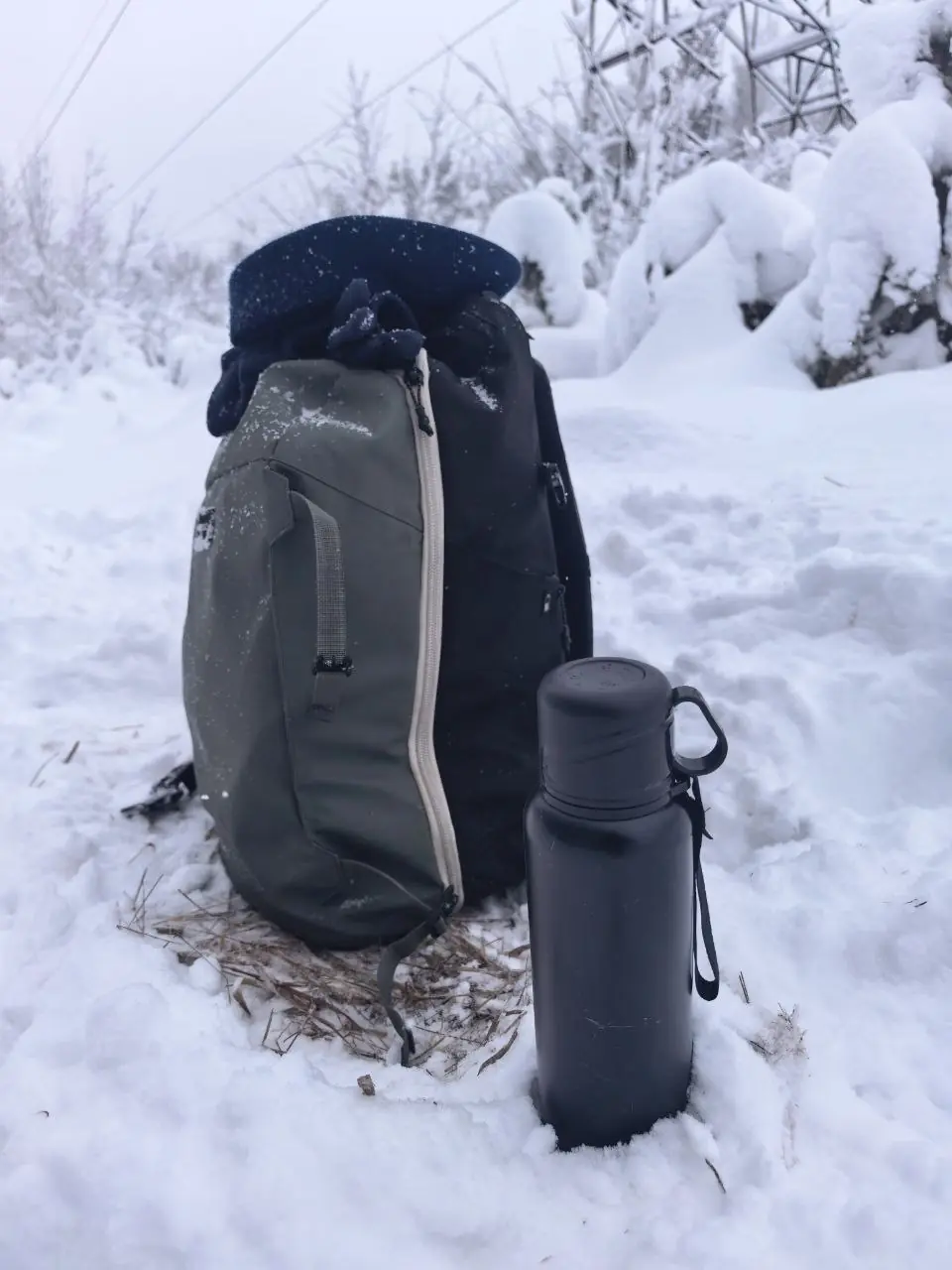
By suburban train:
Trains in this direction run often, but it is better to check the timetable in advance: the interval during the day is noticeably longer than in the morning. On the way back it is convenient to leave from a different station — more on that below.
By car: use Kirovsky district of Leningrad Oblast as your reference point, but bear in mind that there is no parking at the entrance and the nearest U-turn on the highway is a long way off. The suburban train is honestly more convenient here.
The main appeal of this place is that you do not have to come back to your car. You board a suburban train, get off at Ivanovskaya, walk forward through the labyrinth and travel home from a different station. It is not a loop you cut beside a car park, but a real journey: an unfamiliar stretch of forest ahead, and at the end a platform instead of the very same level crossing you started from.
The second advantage of this format is that you do not depend on a car at all: you arrive by suburban train and return by suburban train. For a skier who does not want to drive the same winter highway twice, this is a rare opportunity.
The sounds here switch between three modes. Either complete silence. Or an aeroplane passing overhead. Or the power line humming — and that is the most interesting part.
The density of people here is roughly one skier every ten minutes, and that changes everything: the forest stops being a backdrop and starts showing you what simply does not catch your eye on a popular trail.
Here is one example from a trip: right on the ski track, two steps from the rut, a mouse climbed into its burrow. On trails where many people ski you will not see that — the animal simply does not come out to a groomed track. Here it lives its own life beside you, and that is the best sign that you have ended up not on a "ski avenue" but in a real forest.
The same goes for sounds: either complete silence, or an aeroplane overhead, or the monotonous hum of the power line. Three states with nothing in between — no voices, no music from other people's speakers, no drone of machinery.
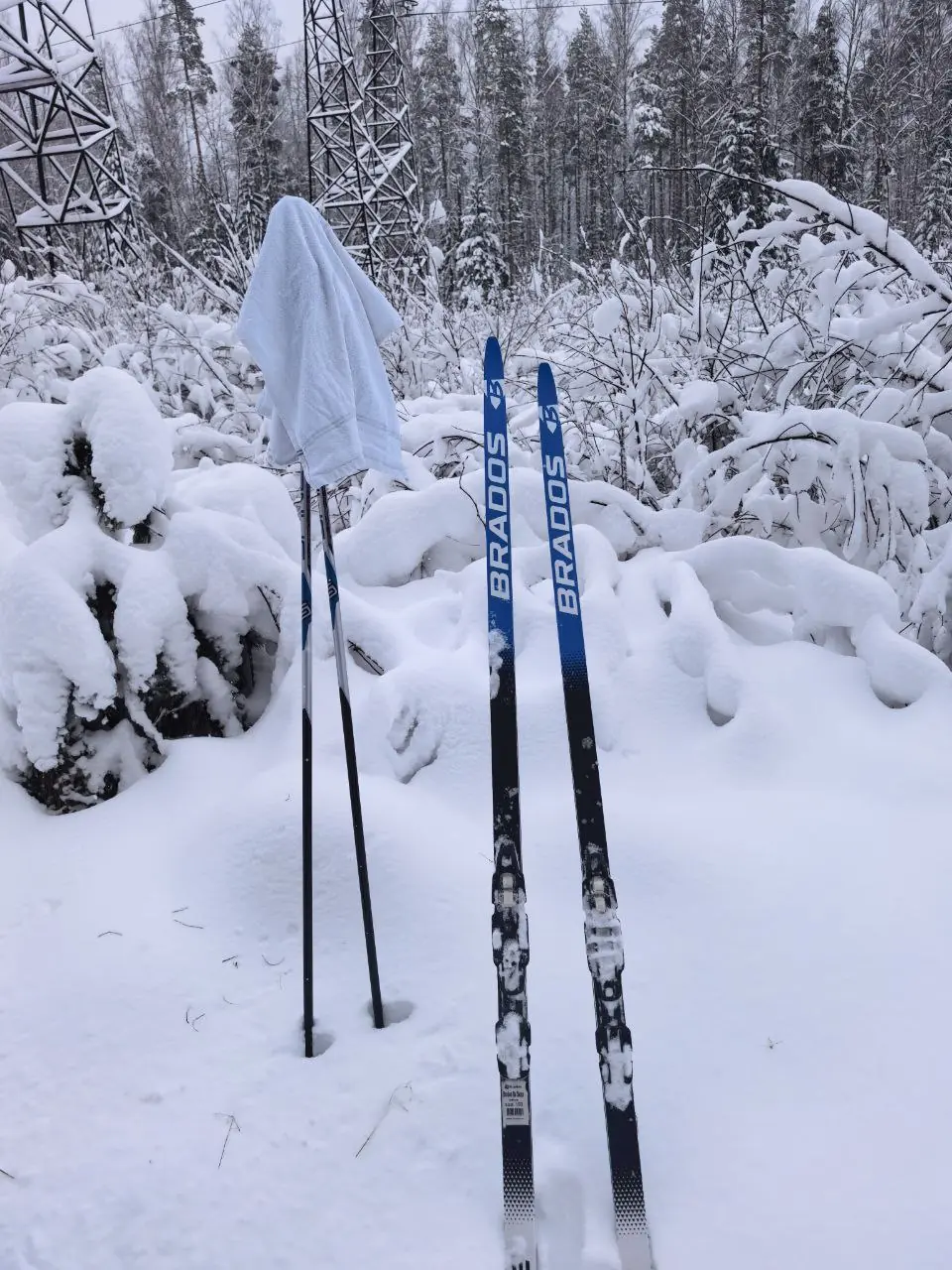
When the ski track runs right under the line itself, you enter a kind of acoustic vacuum: the monotonous buzzing of the wires above, the rustle of snow under your skis, and nothing else. Other sounds seem not to reach you. The feeling is strange and pleasant — but only as long as it does not last; after half an hour the hum starts to press on you.
The defence line of Leningrad ran through here. The ground still remembers it: rusty shells turn up under the snow, and in the forest you can accidentally come across barbed wire. This does not get in the way of a walk and creates no danger, but it adds a completely different dimension to the route: you ski along the track and understand exactly where you are.
One thing worth saying: none of this gets in the way of the ride. A piece of rusted metal you find is a discovery, not a hazard — this area is safe, and these traces add character to the route rather than spoiling it.
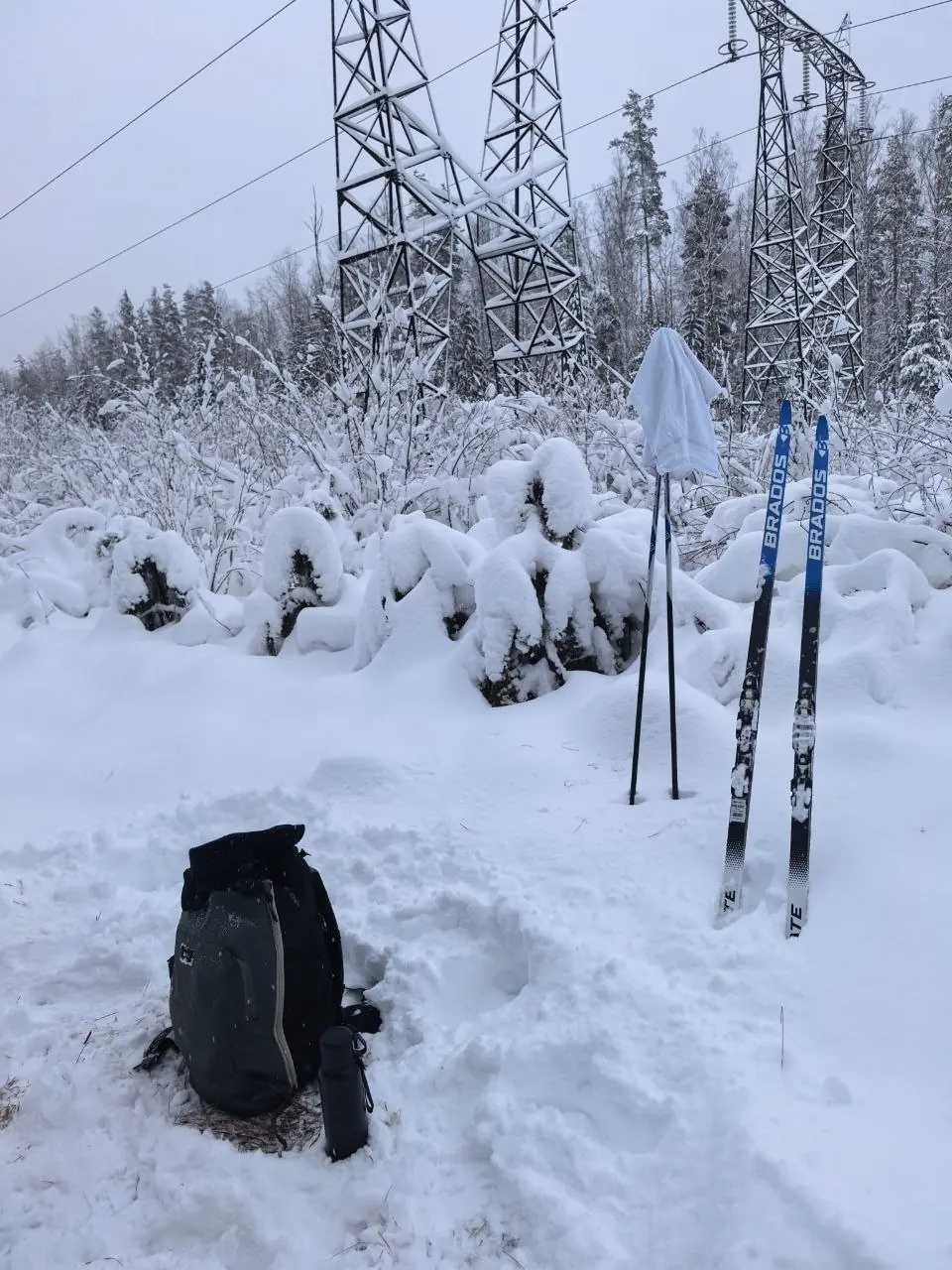
An honest warning that makes this route worth planning in advance.
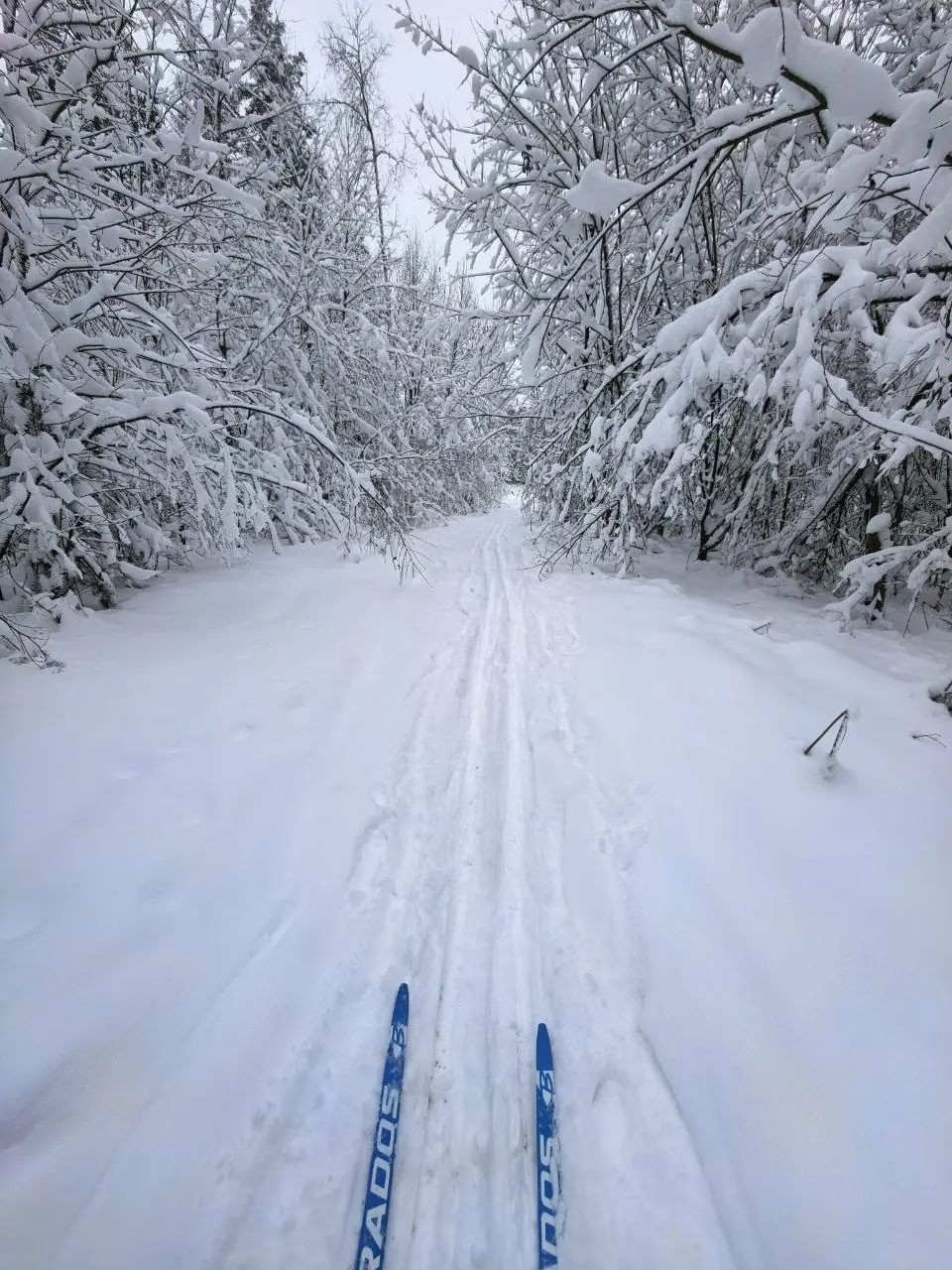
About a kilometre before the railway the groomed ski track ends. Beyond that you are on virgin snow: water-filled hollows and ice lie beneath it. You walk on the crust, and the crust cracks a second before your foot sinks in up to the knee. Wet feet in the cold are cold, not a walk.
The sequence of actions that will save your trip:
there is no internet here, and the mobile signal is barely enough for a call and loading a map, and even that is a struggle. Download the map at home.
to the fork and take a loop back than to push forward through virgin snow.
you will not hear an approaching train at all. This is the main danger of a winter forest beside a railway, and no saving of kilometres is worth it.
In terms of lighting the place is average: there are lamps, but not everywhere. Part of the labyrinth is lit, part of it is completely dark. If you plan to ski in the evening, take a headlamp: without one, half the route simply disappears. More on night trips in the article about night skiing.
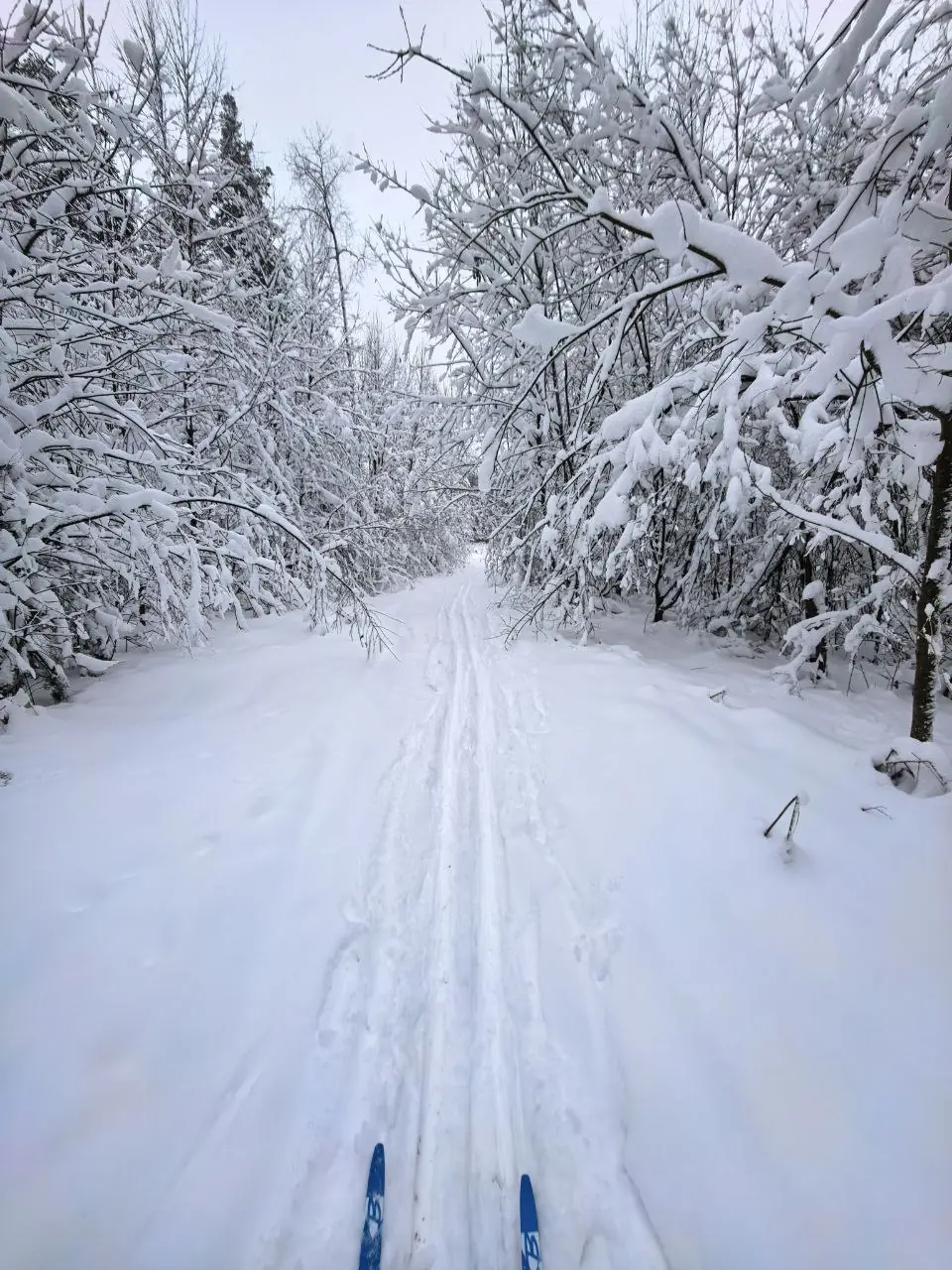
On a skied-in track you can walk — there is an ordinary path running alongside, and pedestrians belong here. But if the ski track is cut and marked, it is better to leave it to skiers: on foot you sink deeper and destroy the grooming. The rule is simple: the ski track is for skis, the path beside it is for walking.
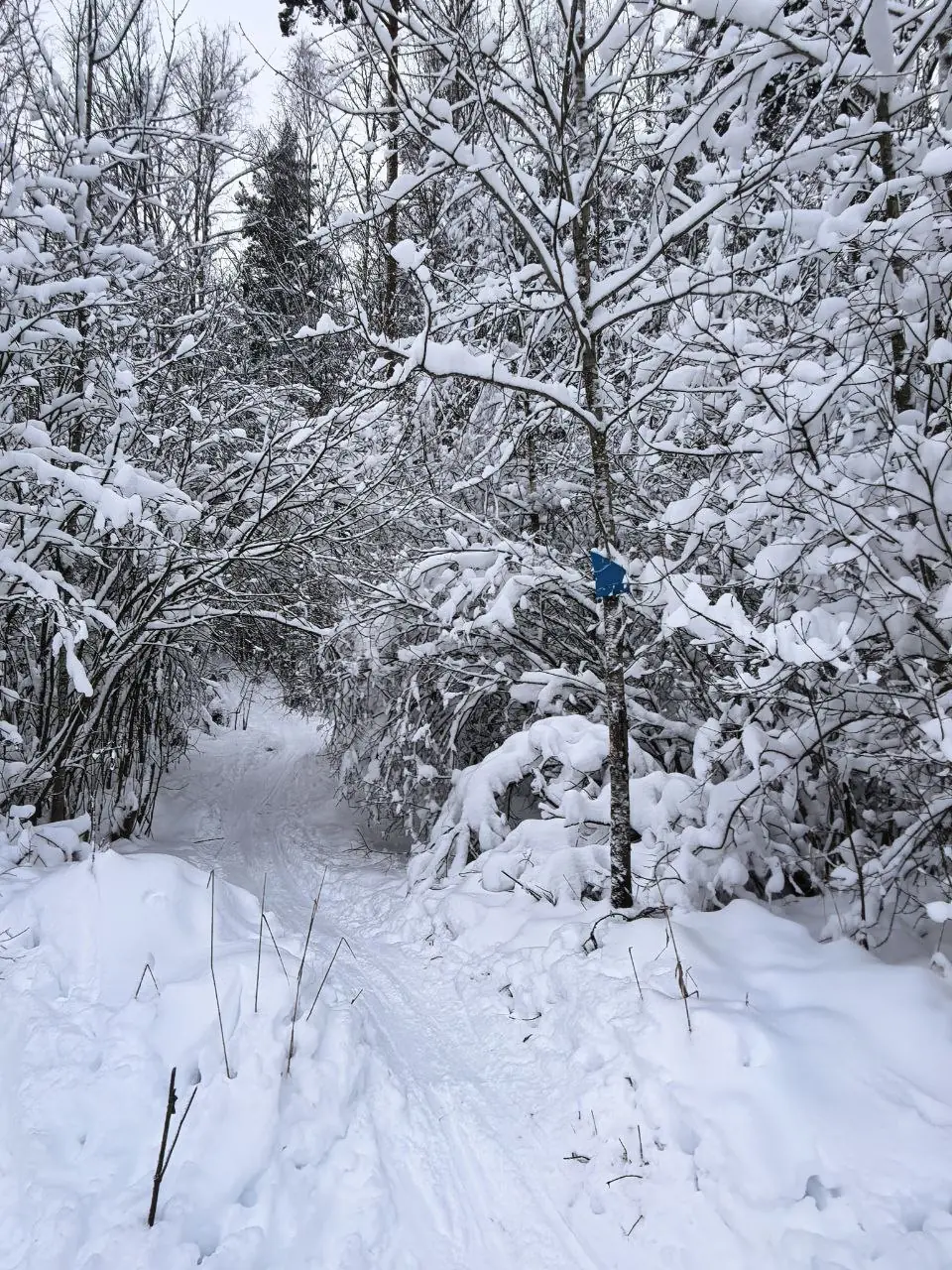
You can, but there is no parking at the entrance, and this is primarily a suburban-train route: it is designed as a journey from point A to point B.
No. This is a recreational ski track with a speed of about 6 km/h. Ordinary classic cross-country skis will do.
There is coverage, but practically no internet: enough for a call and loading a map. Not for social media and feeds. Download the map in advance.
Yes, but only part of the route is lit. You need a headlamp.
Local residents are the ones who use this ski track — people who live here all year round or spend the winter at their dachas: from Otradnoye and the neighbouring garden communities. They are the ones who pack down the main ruts: as long as people ski from their dachas to the station and back, the ski track stays alive. This also explains why the ski track does not run straight through the forest but loops between the plots.
In the forest you constantly see turn-offs and bends — tracks showing where other skiers turned off for some reason. This is one of the most interesting things about a ski track like this: you start wondering why they went that way and what is there. Usually such branches lead to streams, ravines or simply to beautiful spots — and in that sense the ski track turns into exploration.
You can follow them, but remember: this is no longer a groomed ski track but someone else's rut, and it can end anywhere. It is worth keeping the map internal — that is, downloaded to your phone in advance: consult it as you go and understand where you have been carried off to.
While you ski you can look for tracks in the snow. Here small animals run across the paths — you come across the tracks of a fox, a squirrel, birds. They are fun to examine, and time flows faster when you are tracking: while you look around, the kilometres pass unnoticed.
And this is an honest sign that you have not ended up on a busy trail: the fewer human tracks and the more animal tracks around, the more peacefully everything lives here.
The ski track here is not tied to a single station: you can enter this labyrinth from Ivanovskaya, Pella, Gory and Mga — from any of these stations you reach the same forest ski tracks.
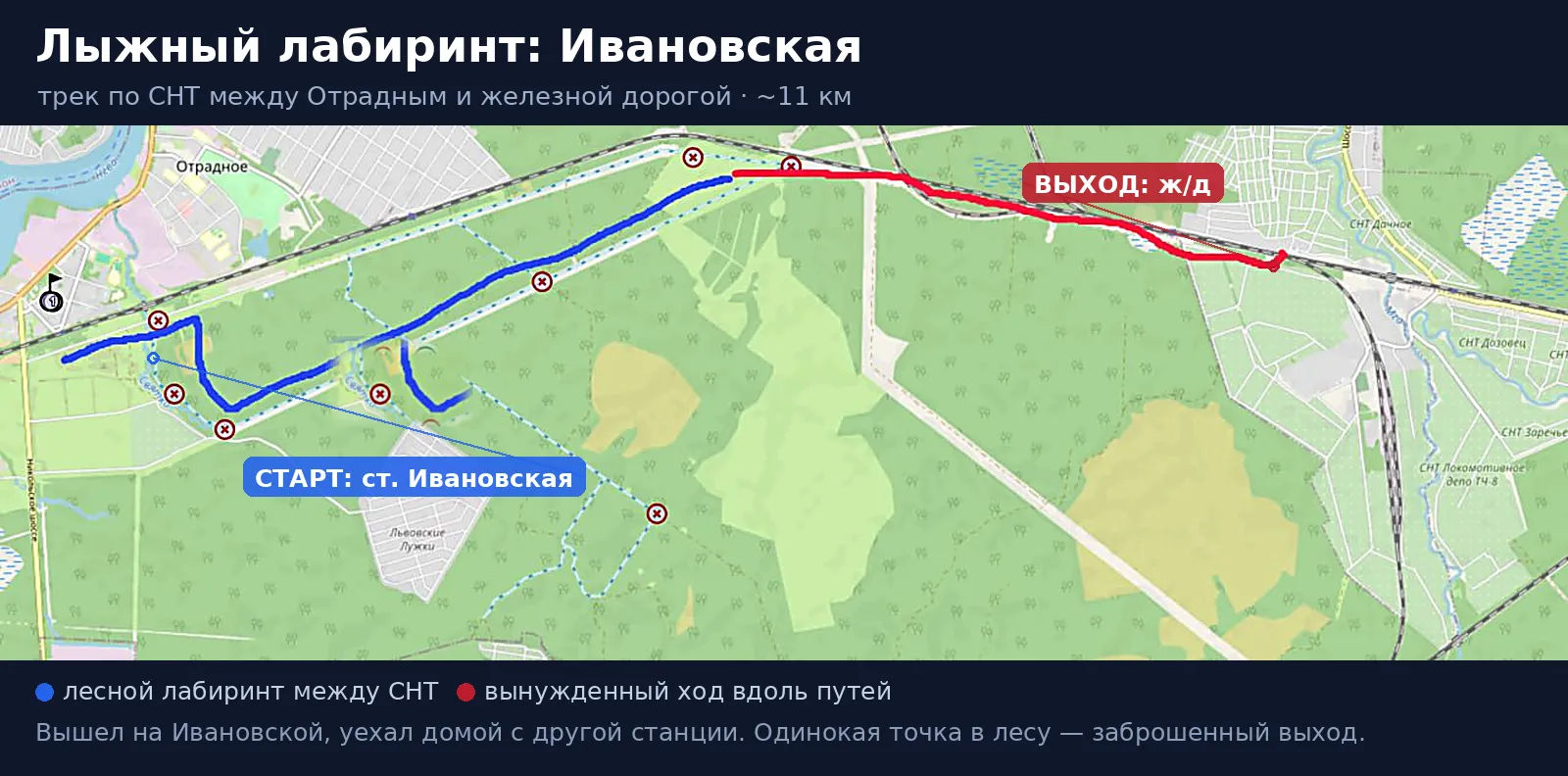
But the simplest and most convenient entry is Ivanovskaya: it is the closest of all, and the ski track starts right at the platform, with no walk through a settlement. The logic is this: start from Ivanovskaya, ski towards the farther stations — and travel home by suburban train from there. That way the outing turns out not as a loop but as a route from point A to point B.
One honest detail about the state of the route: you walk along a road — and sometimes sink into water-filled potholes. While you are dry everything is fine; once you are soaked it is a different matter. After a road like that, wet feet and cold forced me to simplify the route: I stepped onto the railway tracks and walked the last 4 km to the station along them, looking around as I went.
You should not do that: snow deadens sound, and a train approaches almost silently. But it is worth remembering: if the road has turned to slush, the ski route may end earlier than you planned, and then you head back on the same suburban train you started with.