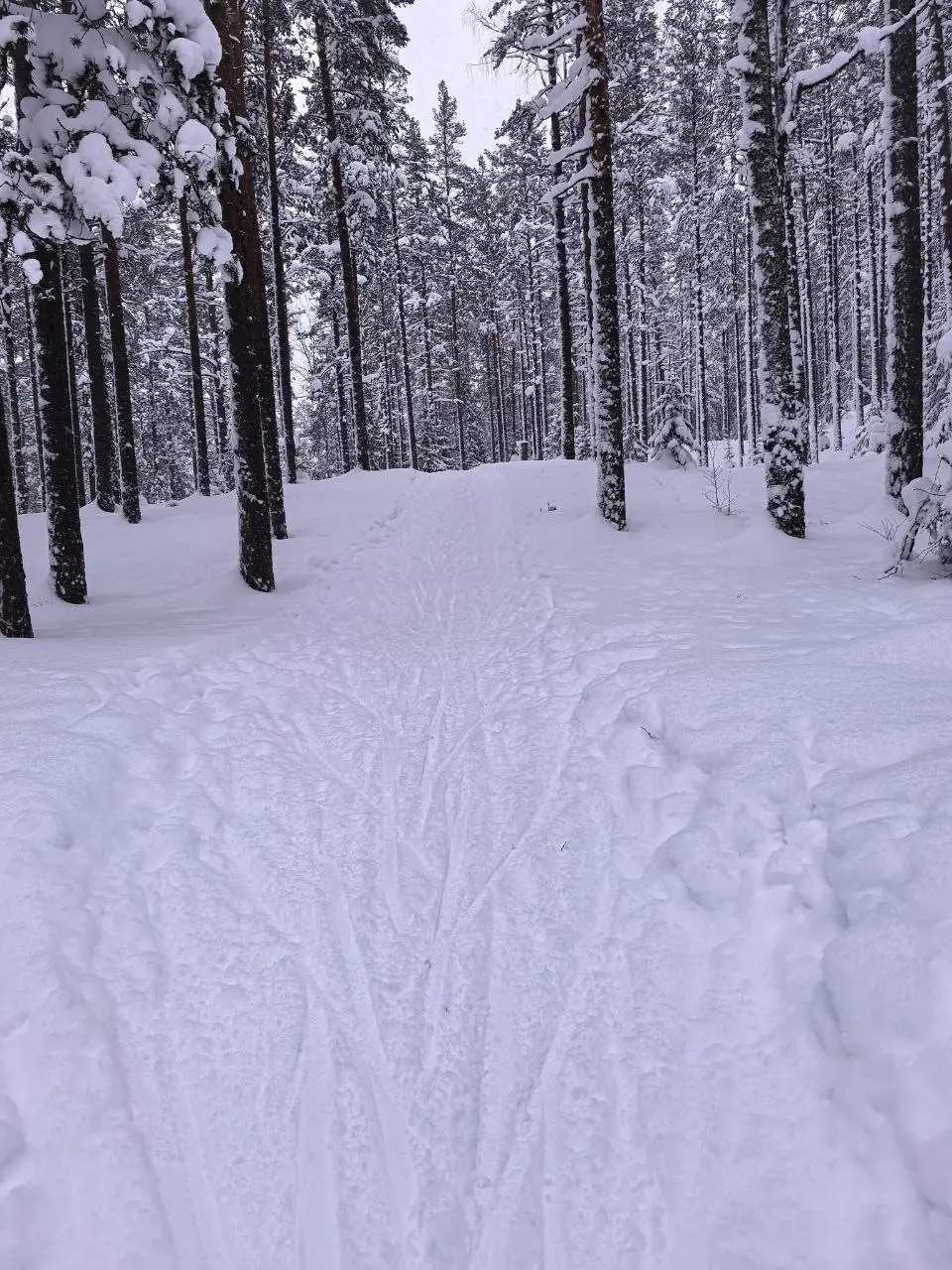
I was skiing along the track when the ski suddenly started coming out of the binding. I tightened it, fixed it properly — and it kept coming loose. Turning back after three kilometres was not appealing, so I dug into my backpack: there was a first-aid kit, and in the kit there was a bandage.
The ride was going fine until the ski suddenly started coming out of the binding. It works like this: you are skiing, and at some point you feel the ski slip out from under your foot. You stop, put it back, tighten the binding, ski on — and after a while it comes loose again.
I fixed it on the spot. Then I fixed it again, properly this time. The ski kept coming loose. That is how kilometre three went.
Then there was a choice: turn back to the station or improvise. I really did not want to end the ride after three kilometres, so I did what almost everyone does on a ski track: I asked an AI model what to do when you are out in the forest and your binding keeps releasing.
The advice was simple and, surprisingly, workable: lash the binding to the ski with duct tape. The logic is the same as with alpine bindings — the goal is not to repair the mechanism, but to stop the binding from leaving your foot and to avoid losing the ski on a descent or in deep snow.
I had no duct tape in the forest. But I did have a first-aid kit.
The kit contained a bandage. That is what I used: I wrapped the binding to the ski, tightly bandaging the binding and the front of the ski and tying it so the wrap would not slide off. Then I carried on.
The ride continued. The wrap held the binding in place: the ski stopped sliding out from under my foot, and the rest of the trip went at its normal pace — not a walk back to the station, but an actual ski ride.
The point of any such wrap is one tie in one place: the binding is pressed down onto the ski and held from the sides, so it no longer has any free play. Whatever you have on hand will do — a bandage, narrow tape, duct tape, a zip tie, a strap, even a bootlace.
What is worth knowing honestly:
All of this has long been in our list of what to take on a one-day ski trip — and here is a live illustration of why.
Improvisation does not always help. Turn back if:
Lash the binding to the ski with whatever you have: duct tape, narrow tape, a zip tie — or, in my case, a bandage from the first-aid kit. It is not a repair, it is a way to finish the ride or reach the station.
Yes. A bandage is elastic, so it needs a tighter wrap with more turns than duct tape, and you should keep an eye on it so the wrap does not slide.
If the binding has torn out of the ski, the ski is cracked, or the wrap will not hold on the first attempt — head back to the station while you still have daylight.
Duct tape or narrow tape, a couple of plastic zip ties, and a screwdriver that fits the binding screws. A first-aid kit is worth the weight too — in this story it saved the ride.