Where to ski cross-country near St Petersburg: groomed trails with marked loops, forest tracks running between dacha communities, and point-to-point routes. With transport, distances and the rules that apply on each trail.
Ski trips near St Petersburg fall into two fundamentally different types — and your expectations should match each one.
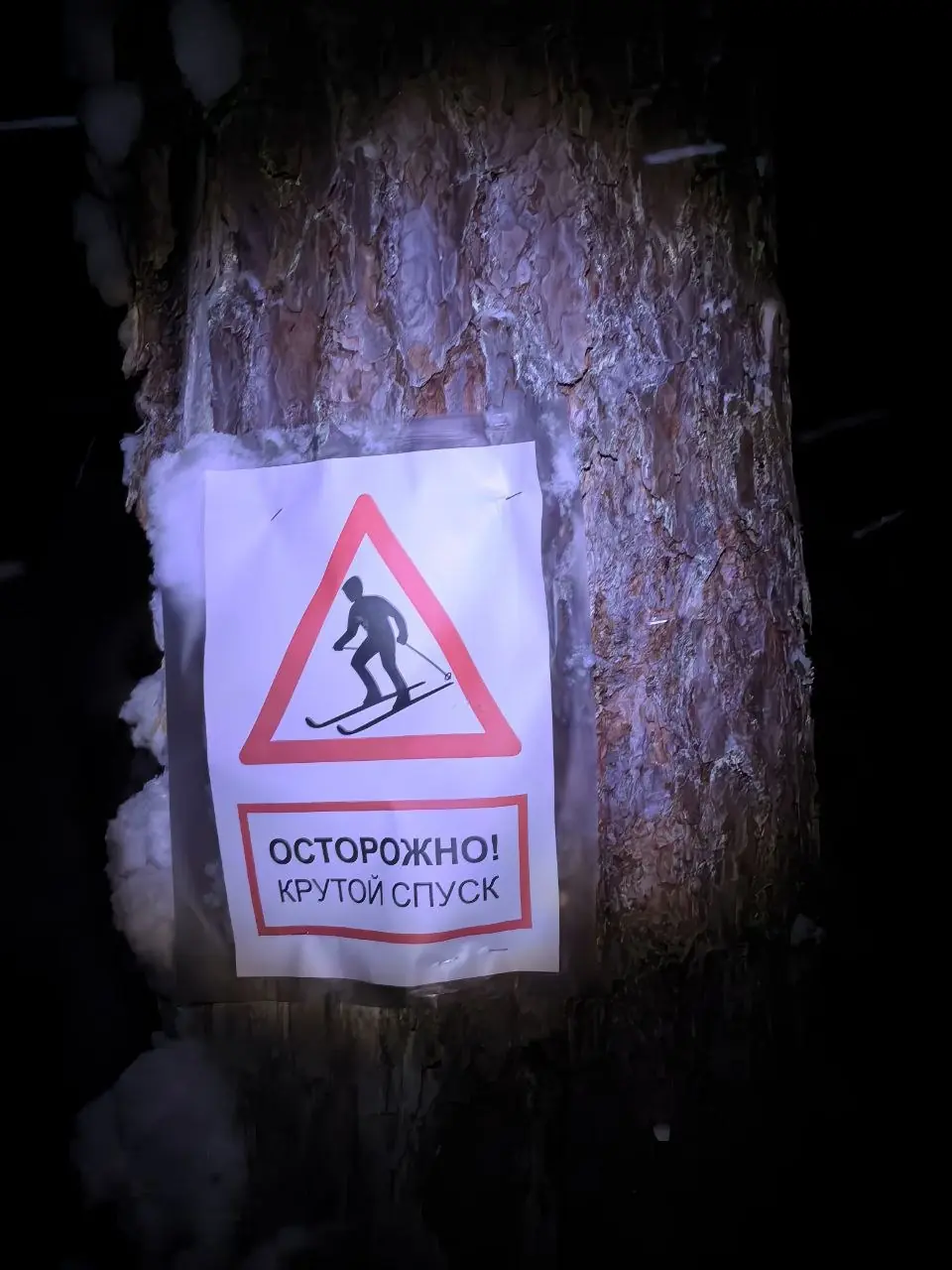
A groomed trail. Loops are marked out by the kilometre, the track is cut by a snowmobile, and there are signposts and warning signs on the descents. You can ski at a pace, count the kilometres and know that in an hour you will be back at the same spot. There are not many places like this in the region — they survive on the people who groom the trail, not on public money.
A forest route. No grooming at all: a track packed down by other skiers, forest and garden-plot roads, clearings under power lines. There are no kilometre posts and no guarantee that the way ahead is passable. What you do get is no queue on the trail, and a real forest.
The choice is not about which is better but about matching the task: a training session and a predictable loop is the first; quiet, unfamiliar forest and a route from point A to point B is the second.
Six points that come up in this article. Click a marker and it will show you what the place is; the list under the map is clickable.
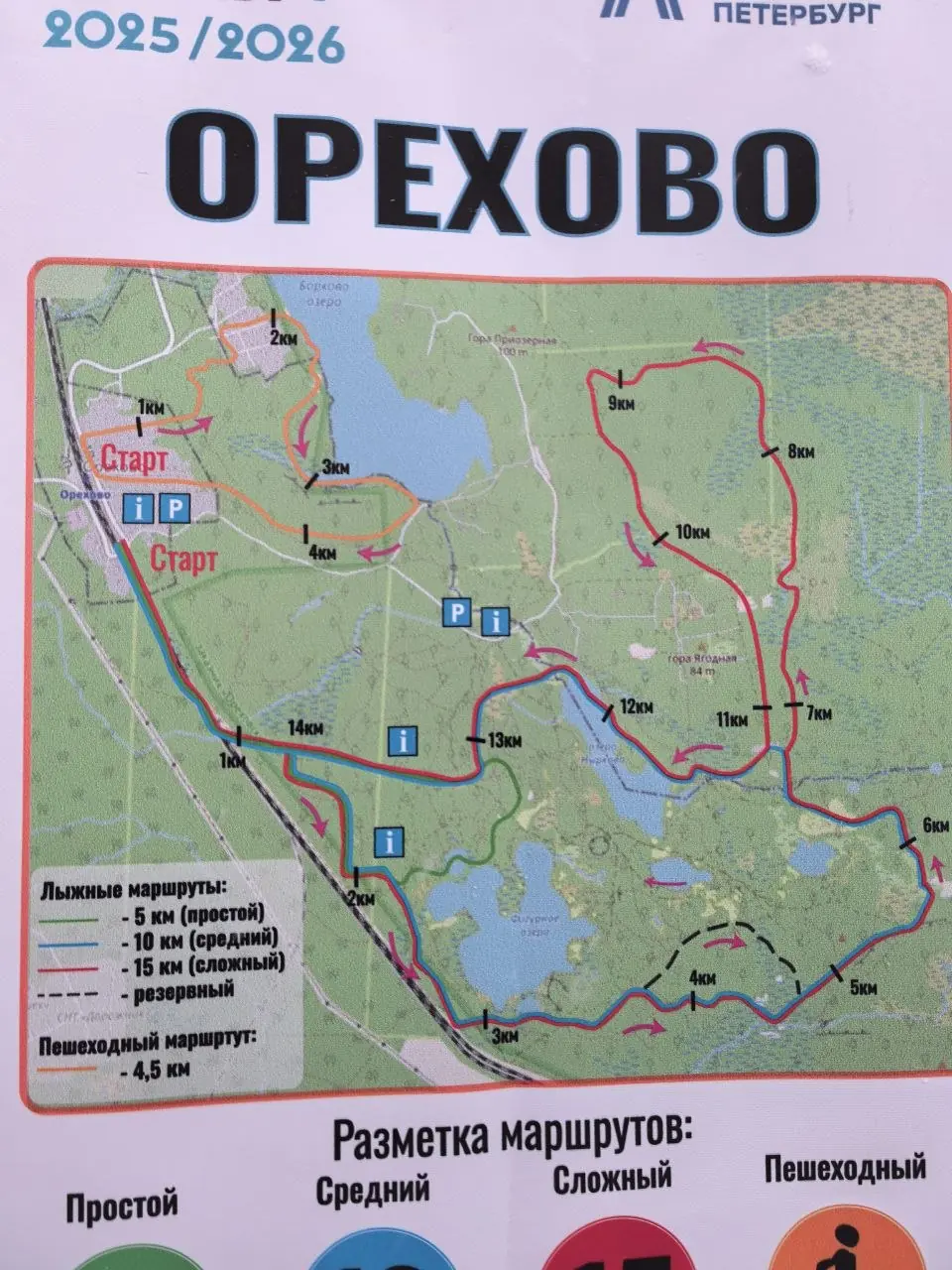
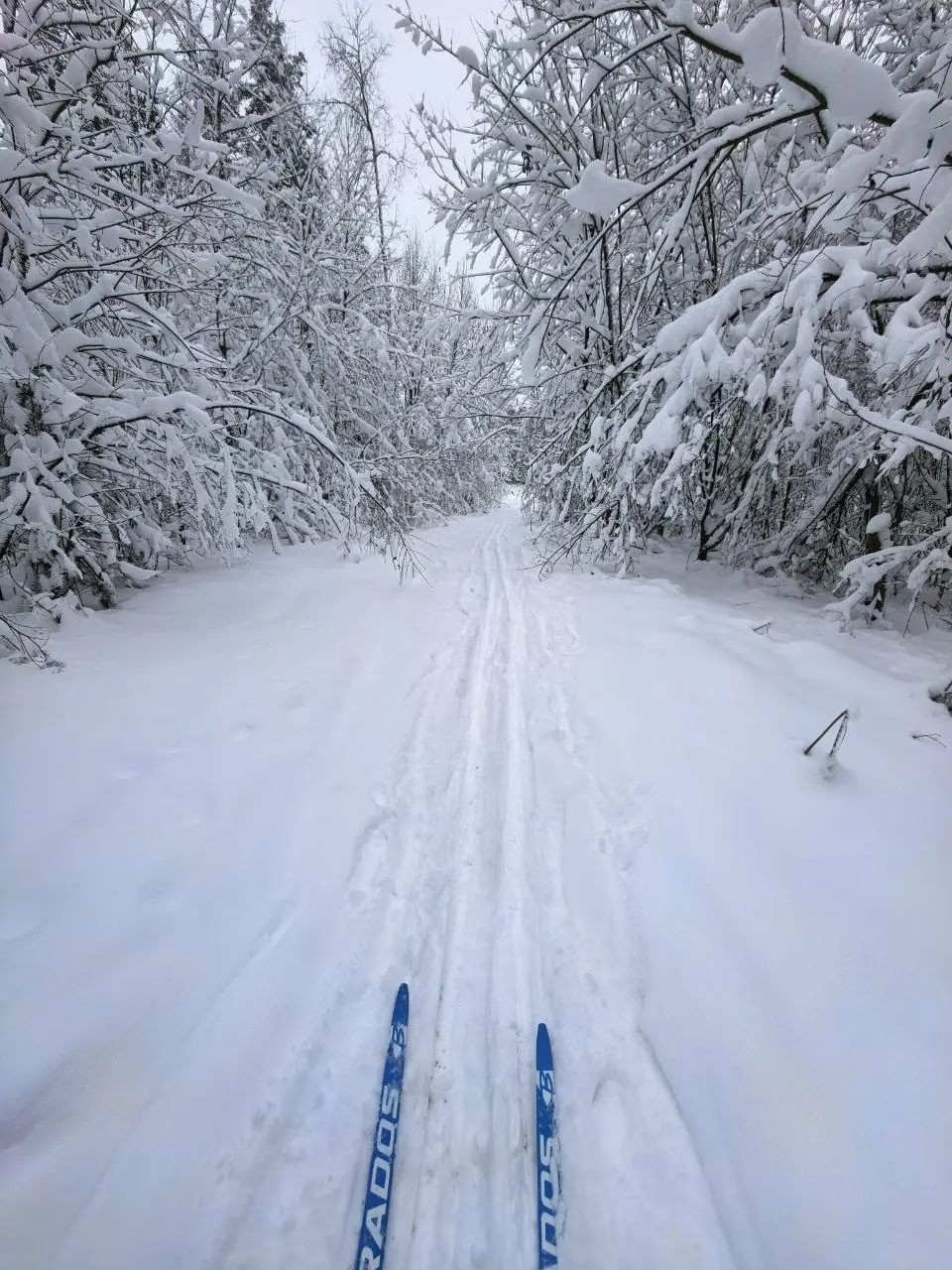
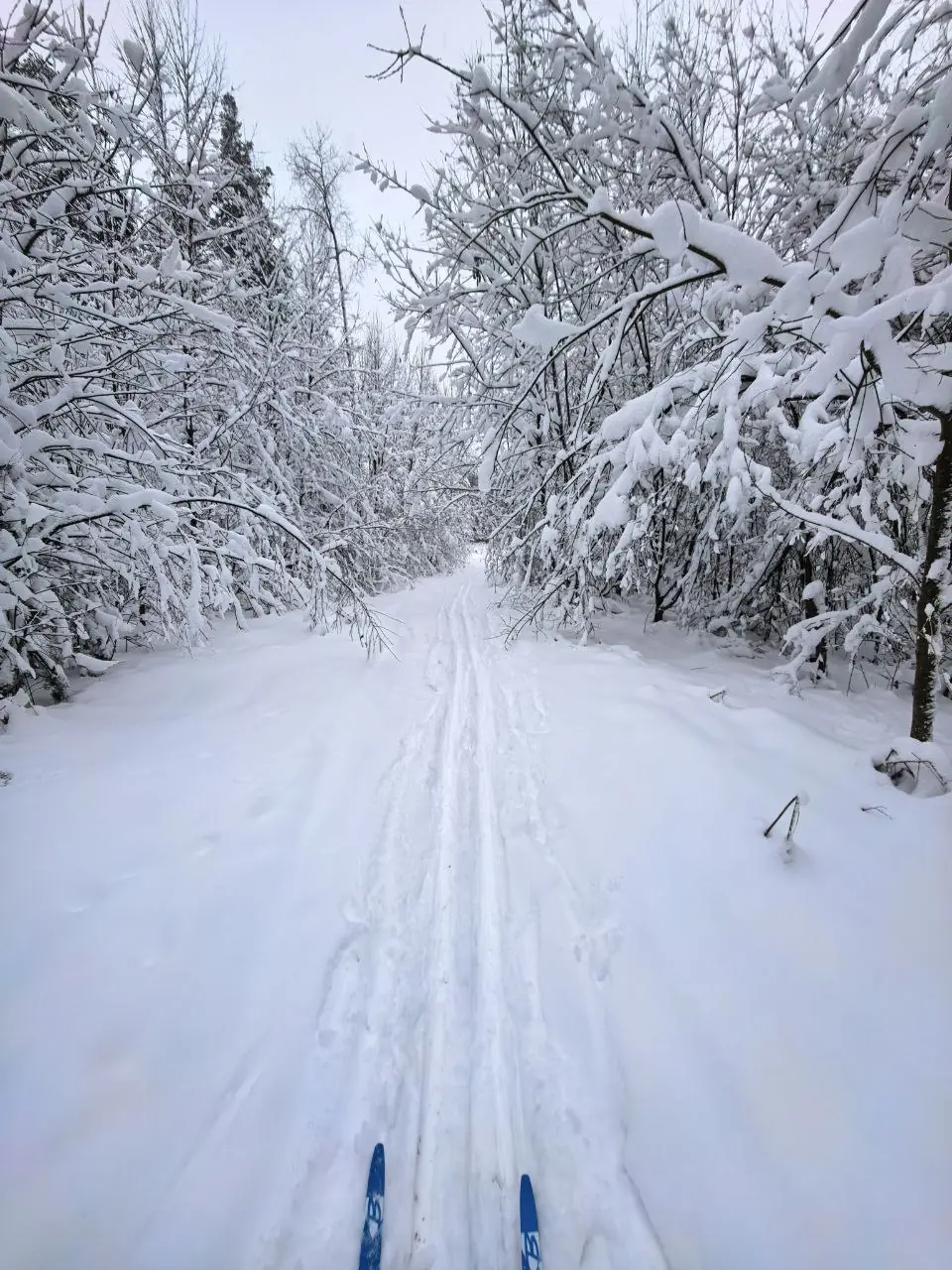
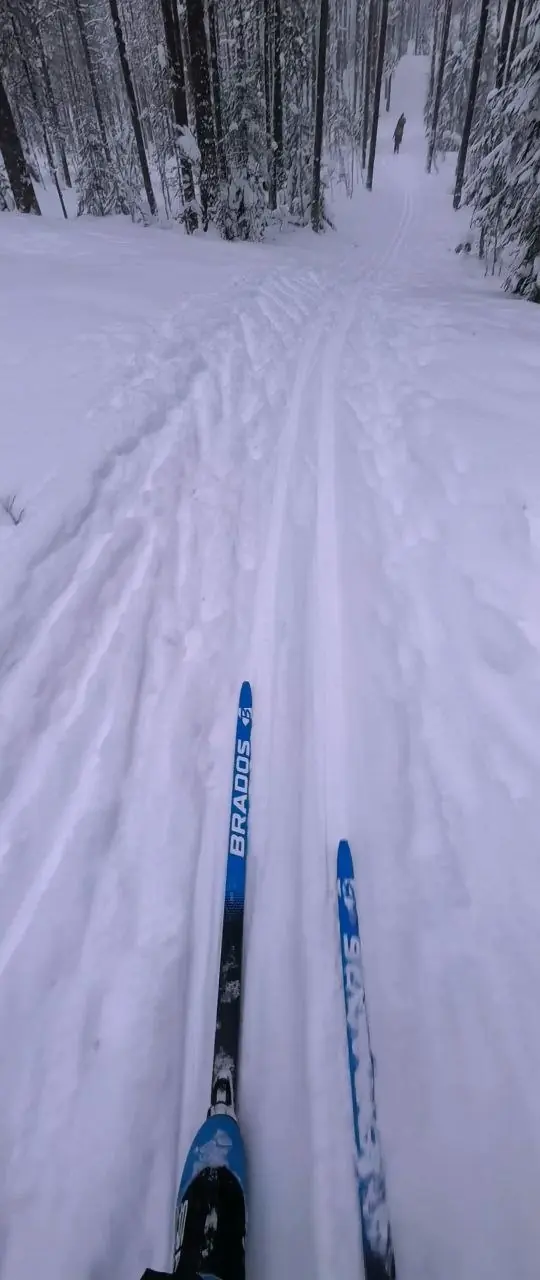
The most straightforward option for anyone who wants loops. Marked at 5, 10 and 15 km, there is a reserve shortcut route you can use to change the loop each time, and a separate 4.5 km walking route. The track is groomed by snowmobile, and the descents are signposted.
The economics of the place are a story in themselves: entry is free, and the trail survives on voluntary donations to the person who grooms it. Those who ski regularly pay around 300 roubles a month and consider it normal: the track is cut and you can ski all season.
There is no light on the trail itself — lamps only at the entrances. The details, a diagram of the loops and how to get there are in the article about the Orekhovo ski trails.
The only trail in the region you can confidently call lit: the first few hundred metres run under light, and beyond that you need your own lamp. Marked in loops of 1, 2, 3 and 5 km, plus a separate «Bolotny Krug» (Swamp Loop) of 2.3 km in classic style — it runs straight across a bog. The area is set aside for skiing: you cannot walk around the loops, there is a separate path for strolling; motorbikes, quad bikes, snowmobiles, horses and cars are banned on the trail.
Important: you cannot get to the trail by suburban train — the nearest station is about 20 km away, so the main option is a car. This is the same Kirovsky district as the ski labyrinth at Ivanovskaya.
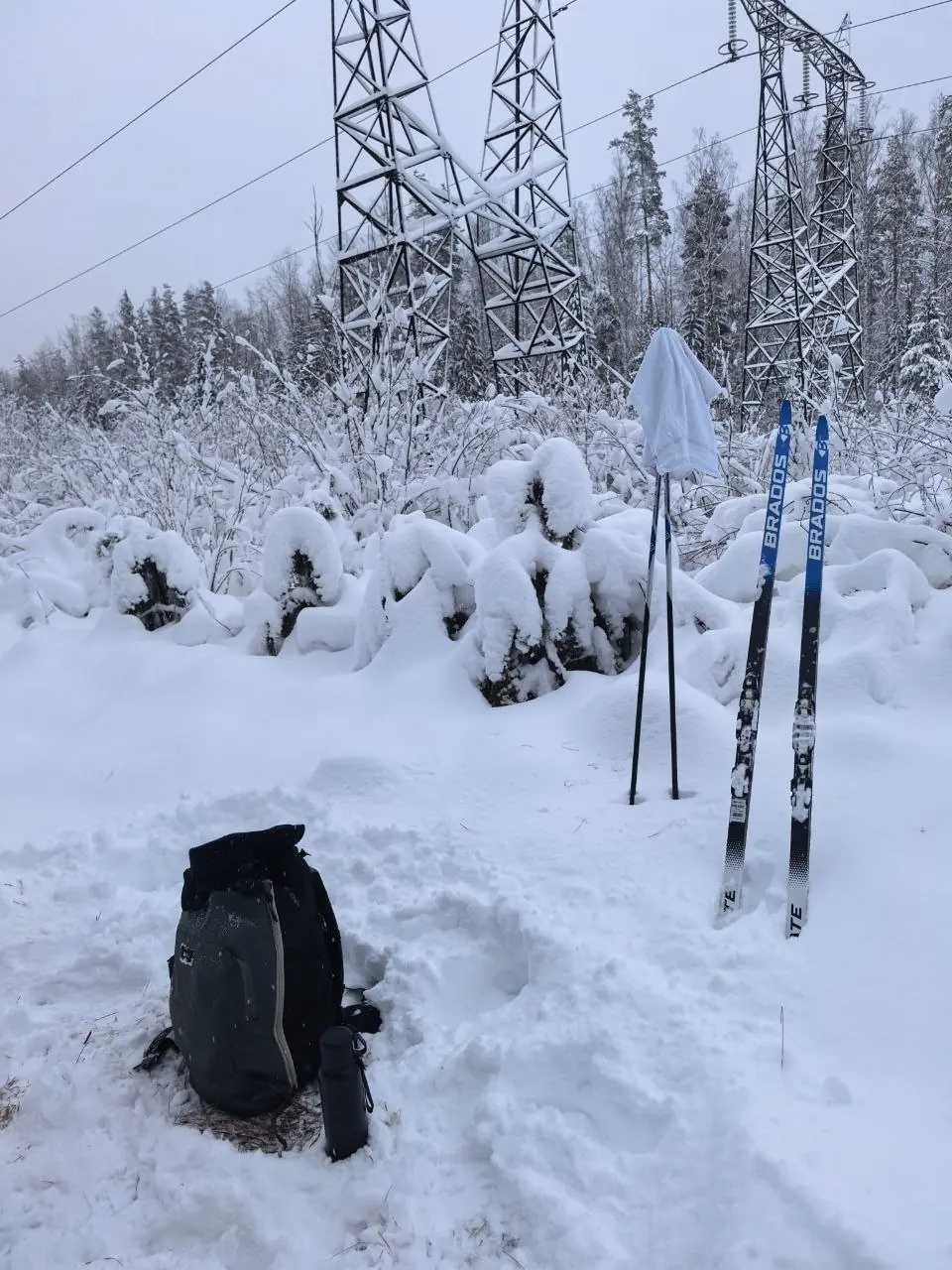
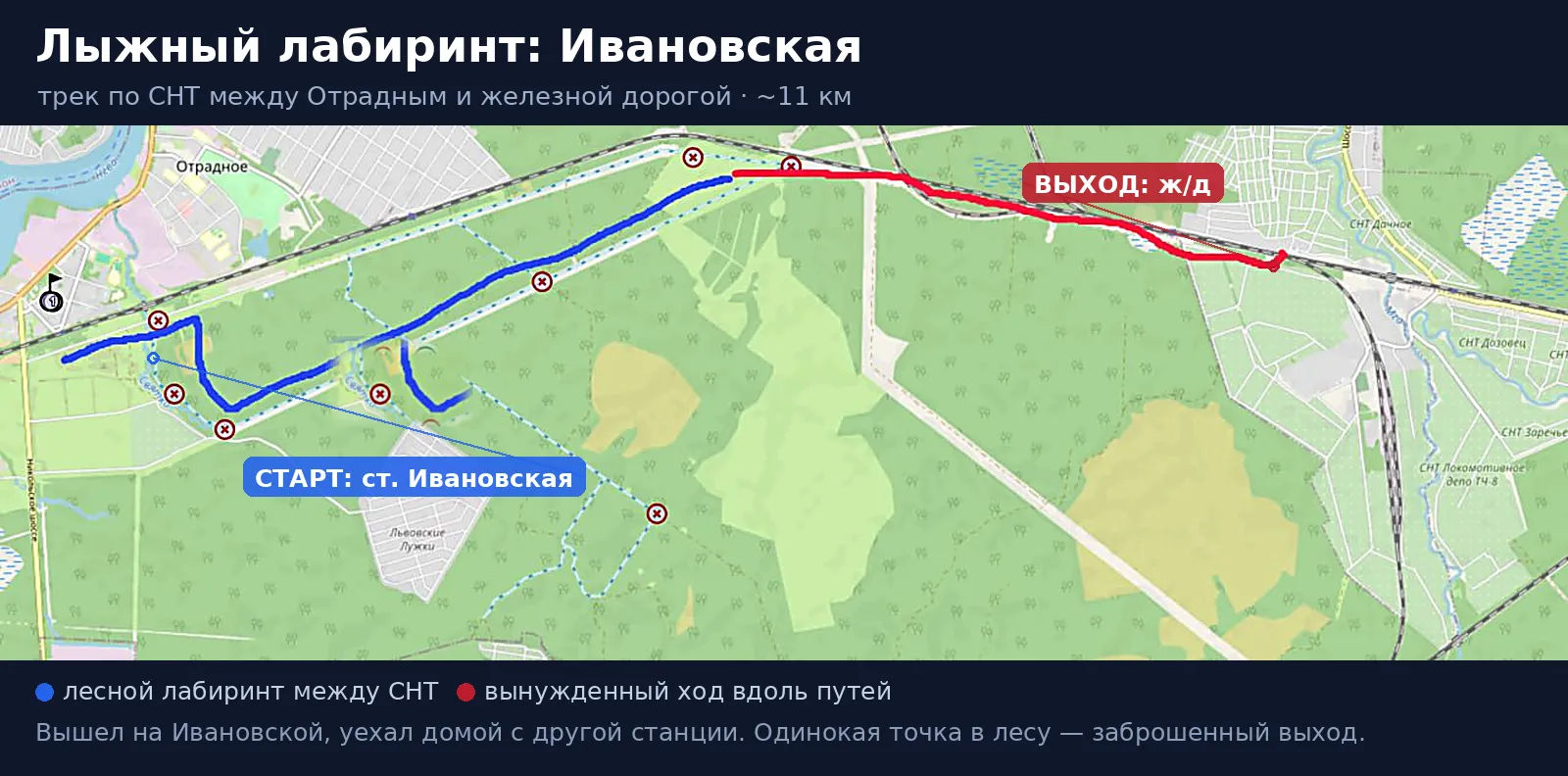
If you want a real route rather than a loop, start with Ivanovskaya. There the ski track does not run from point A to point B: it links dozens of garden communities to one another, and what you get is a labyrinth — squares, zigzags, crossings. A power line runs through the middle, and the main ski track follows it.
What you need to know before you set off:
The full breakdown, including the military history of these places and the rules for getting out, is in the article about the ski labyrinth at Ivanovskaya.
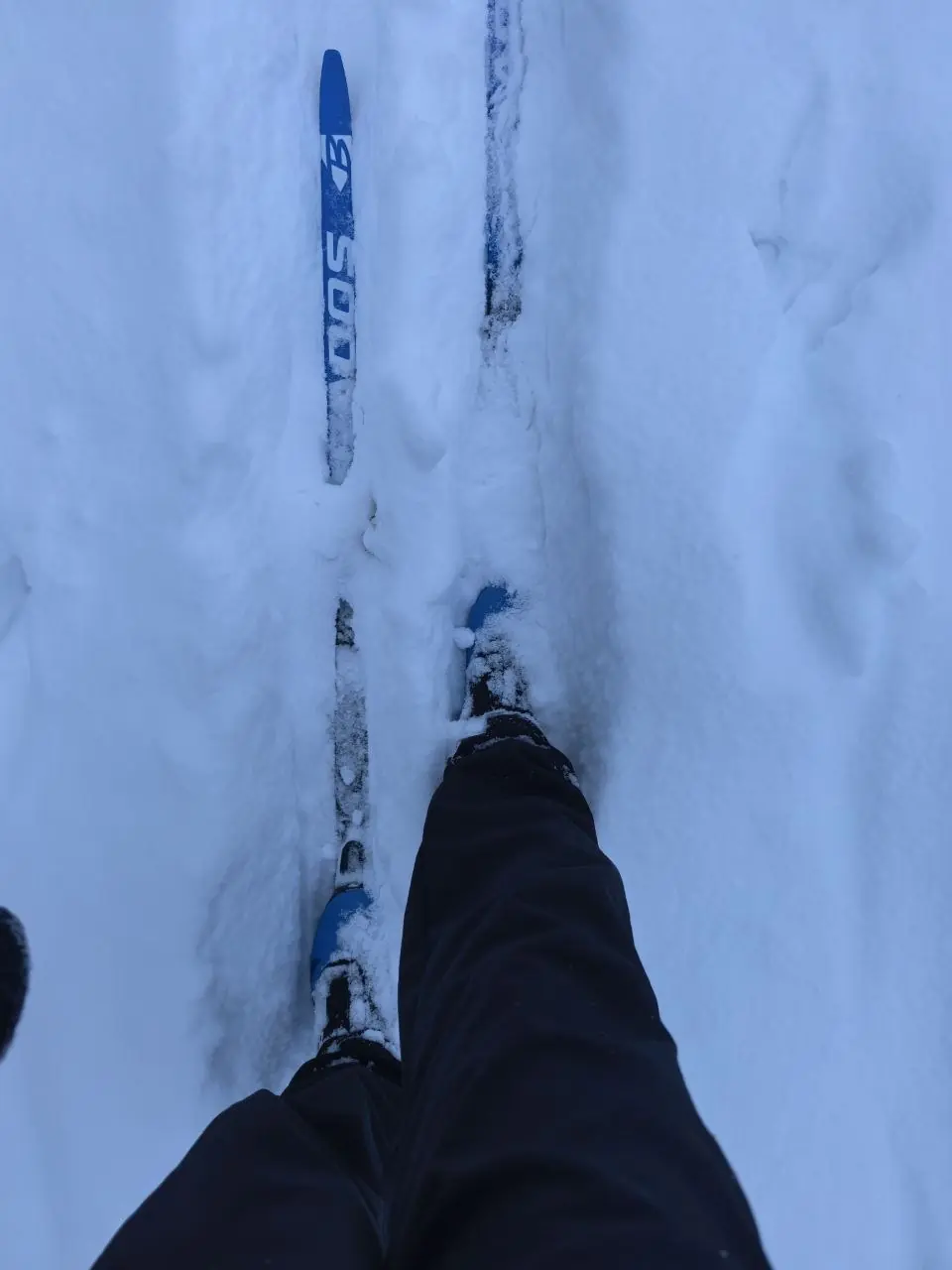
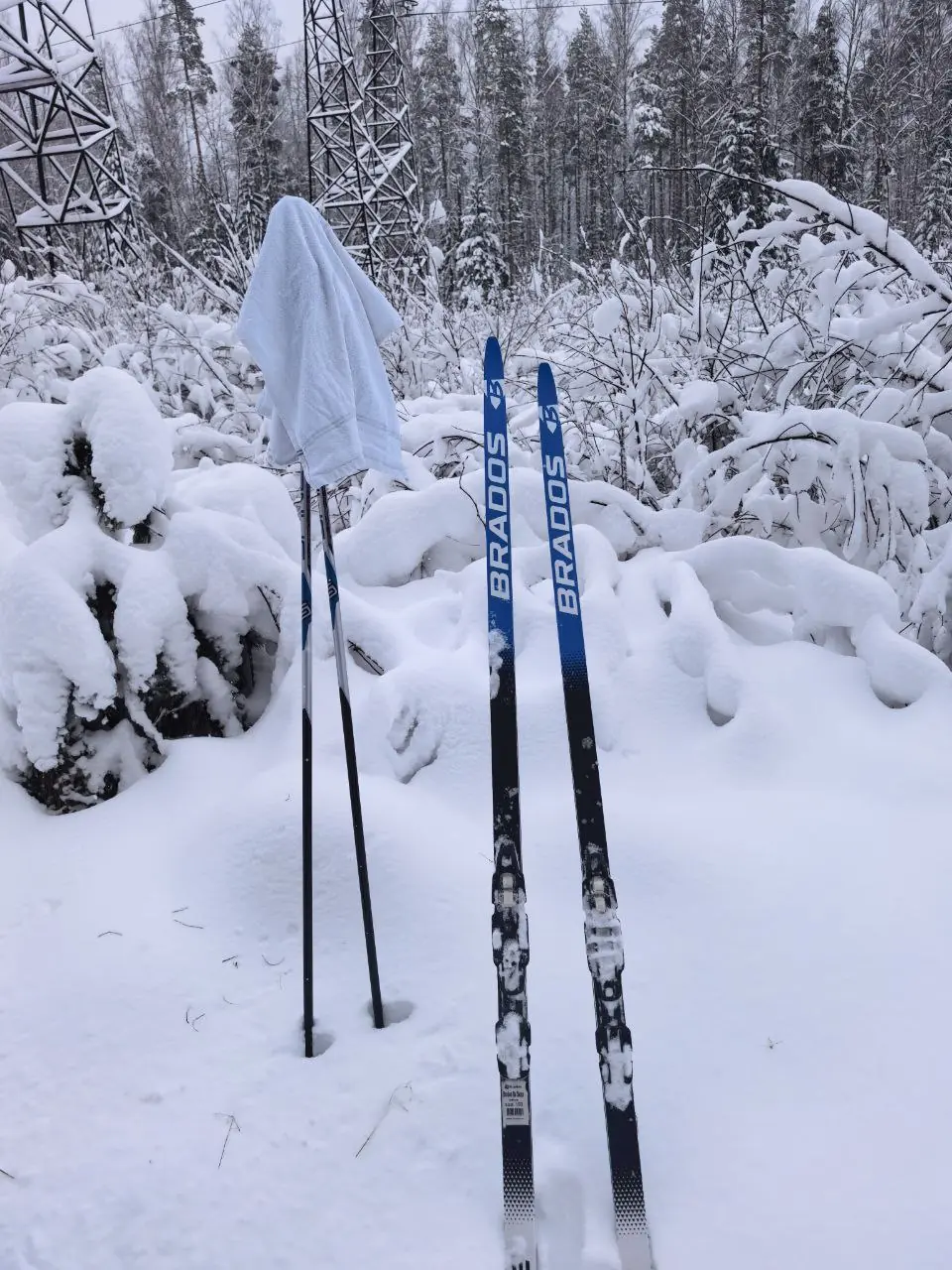
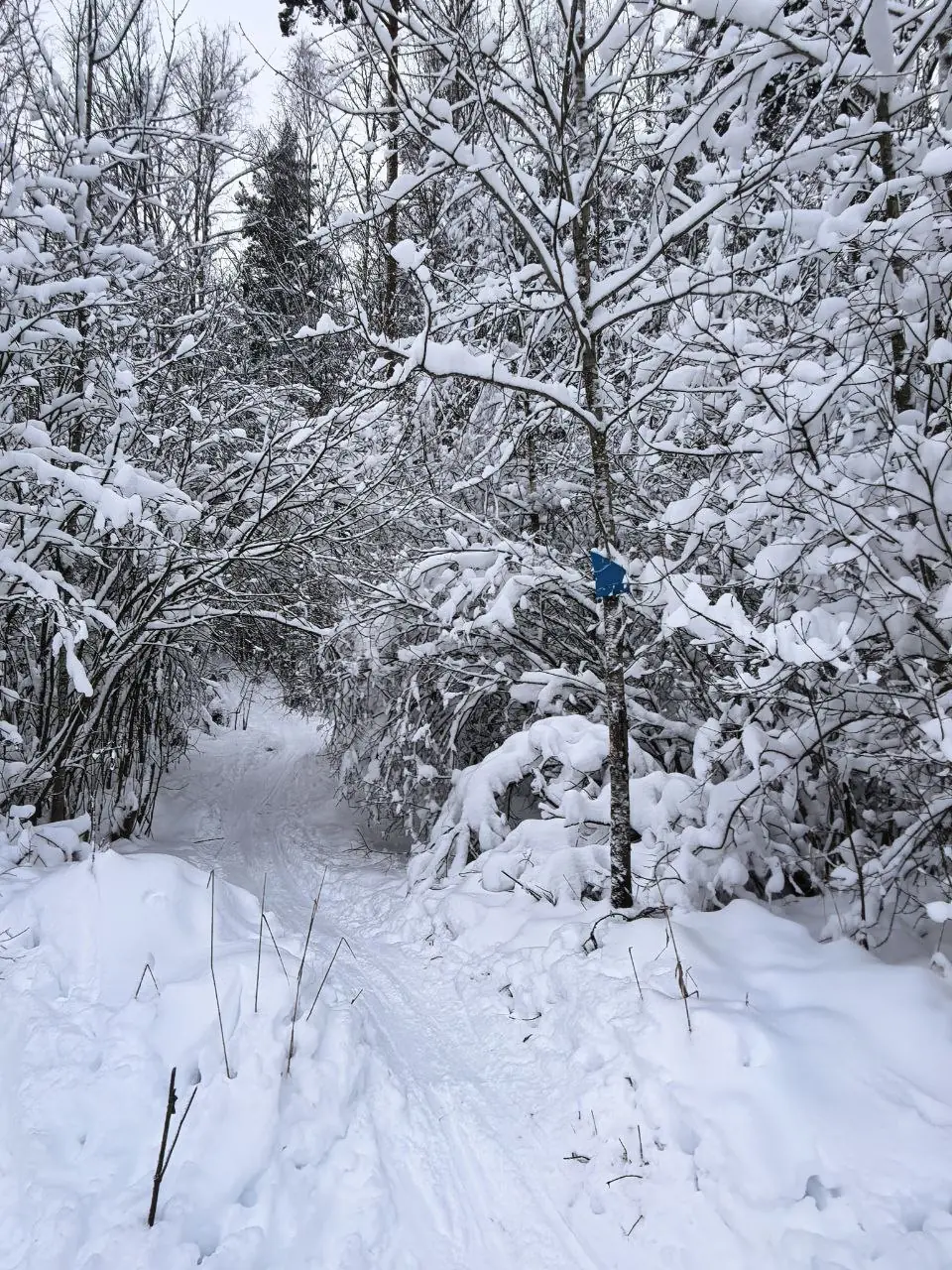
Most ski trips are loops around the car: you drive to a car park, ski, and come back to the same spot. There is a more interesting option: take the suburban train, get off at one station, follow the route onwards and travel home from a different station.
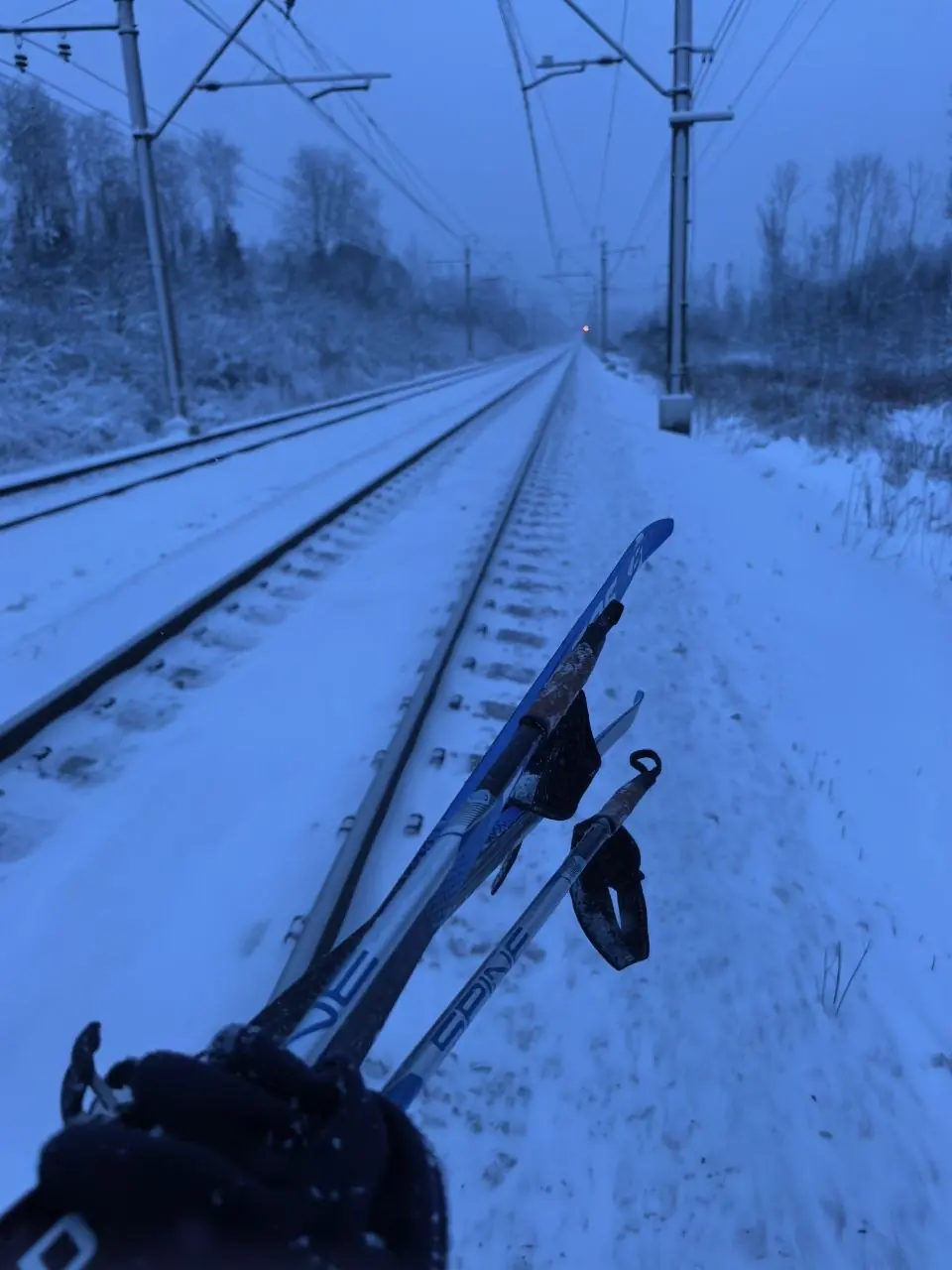
What you get out of it:
There is exactly one downside: you have to plan the route on a map in advance. But for a skier who is out for technique rather than speed, it is the best way to spend a day.
Four questions that answer almost every doubt.
How much time do you have? For 2–3 hours, a groomed trail next to the suburban train. For a full day, a forest route that finishes at a different station.
Do you have a car? No — pick places by the stations. Yes — look for an easy way in, and do not forget that in the evening after skiing you want warmth right away, not a hunt for a lift.
Are you ready for uncertainty? A groomed trail is predictable: signs, kilometres, a cut track. A forest route is reconnaissance: the track can end, there is no marking, and part of the way you have to work out for yourself.
Are you going in daylight or in the evening? If it is after work, factor in the light straight away. There are almost no lit ski trails near St Petersburg, and your whole trip will run on a headlamp.
A separate topic that explains a lot about skiing in the region.
A good ski trail is not asphalt and it is not a signboard. It is a person with a snowmobile who goes out every week and cuts the track. There is usually no public money for it and no ticket office either: entry is open, parking is free, and the trail survives on voluntary donations from the people who use it.
How it works in practice (the Orekhovo example): in the trail community you can send money directly to the person who grooms it — so that he clears more and makes it better. One adult skier pays around 300 roubles a month and considers it normal: the trail is cleared, the track is cut, and a year from now he will still be using it.
Hence a simple rule worth taking with you: if you ski regularly on a groomed trail, support the person who grooms it. That is the difference between “there used to be a good place” and “the track is there all season”.
In short: there are no special rules or tickets for skis. On suburban trains skis are carried as hand luggage if they do not get in other passengers’ way: in the vestibule or on the platform by the doors, upright, with the cover against the wall. Rush hour is the only real limit, so do not try to board the morning train with two pairs held crosswise.
We went through the full mechanics of carrying sports gear — hours, cost, what to do if the vestibule is taken — in a separate article about taking a bicycle: the rules work the same way, only the shape of the load changes.
The ski season in Leningrad Oblast is short and capricious: snow can lie from late November to March, or it can vanish in a thaw in the middle of January. What follows from that in practice:
A short list that covers almost every problem on a winter trip:
Signs that a place is looked after, before you even put your skis on:
If none of that is there but the ski track is, you are on an unofficial route: you can ski it, but you have to plan it as reconnaissance.
First: underestimating the water under the snow. A forest ski track can look flat and well packed, with holes full of water underneath that look no different from snow on top. You ski on, the crust cracks, and a second later your leg goes in up to the knee. The result is feet soaked in freezing weather and a trip that is over. The cure is two habits: spare socks in a dry bag and a decision to turn back the moment the ski track disappears.
Second: working out the way out as you go. The most common failure: a nice start, a long ski, and then the track leads to where it ends — a kilometre short of the station, into untouched snow. Plan the exit, not the entrance: where will you be if you get tired or it gets dark.
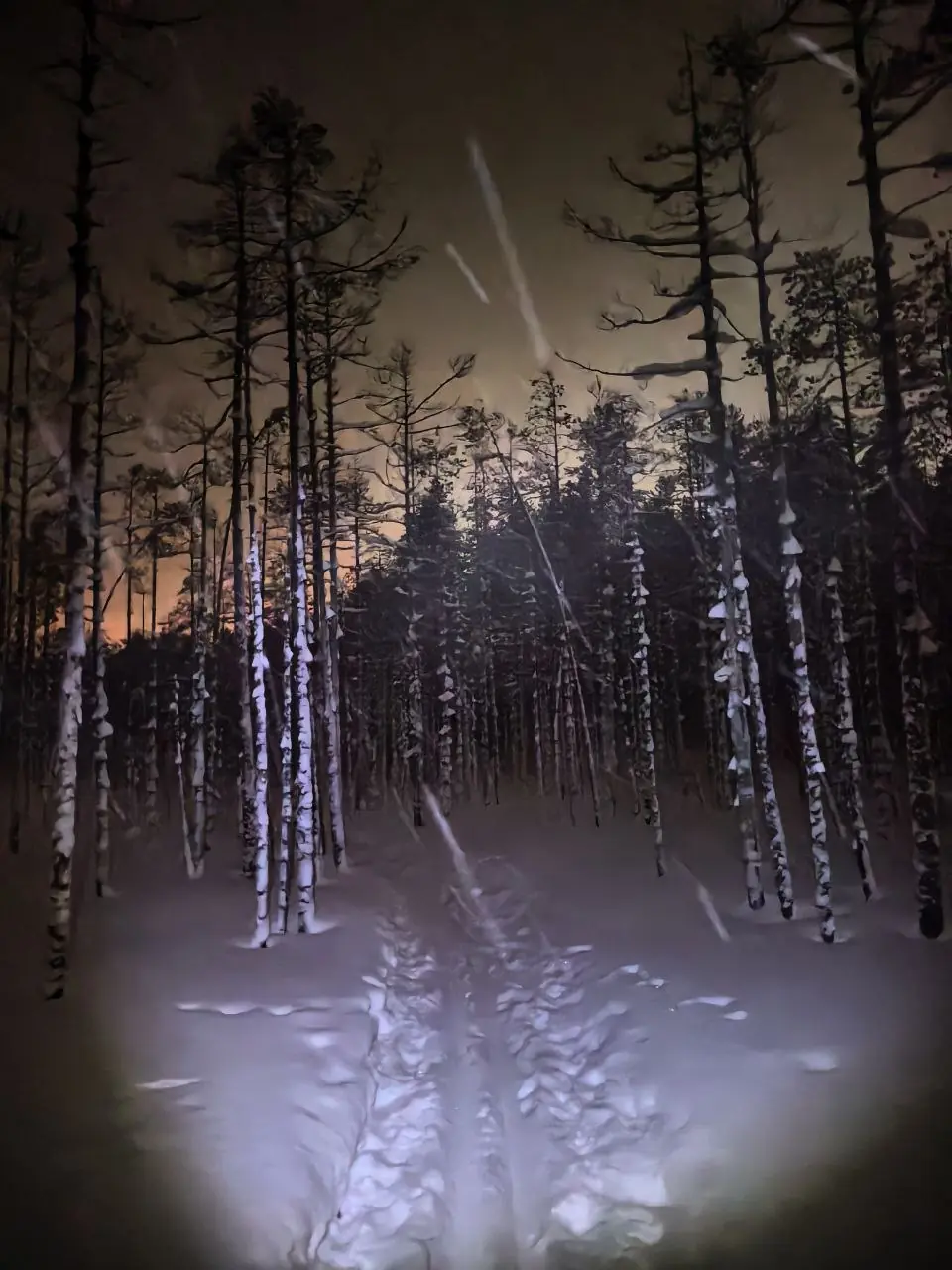
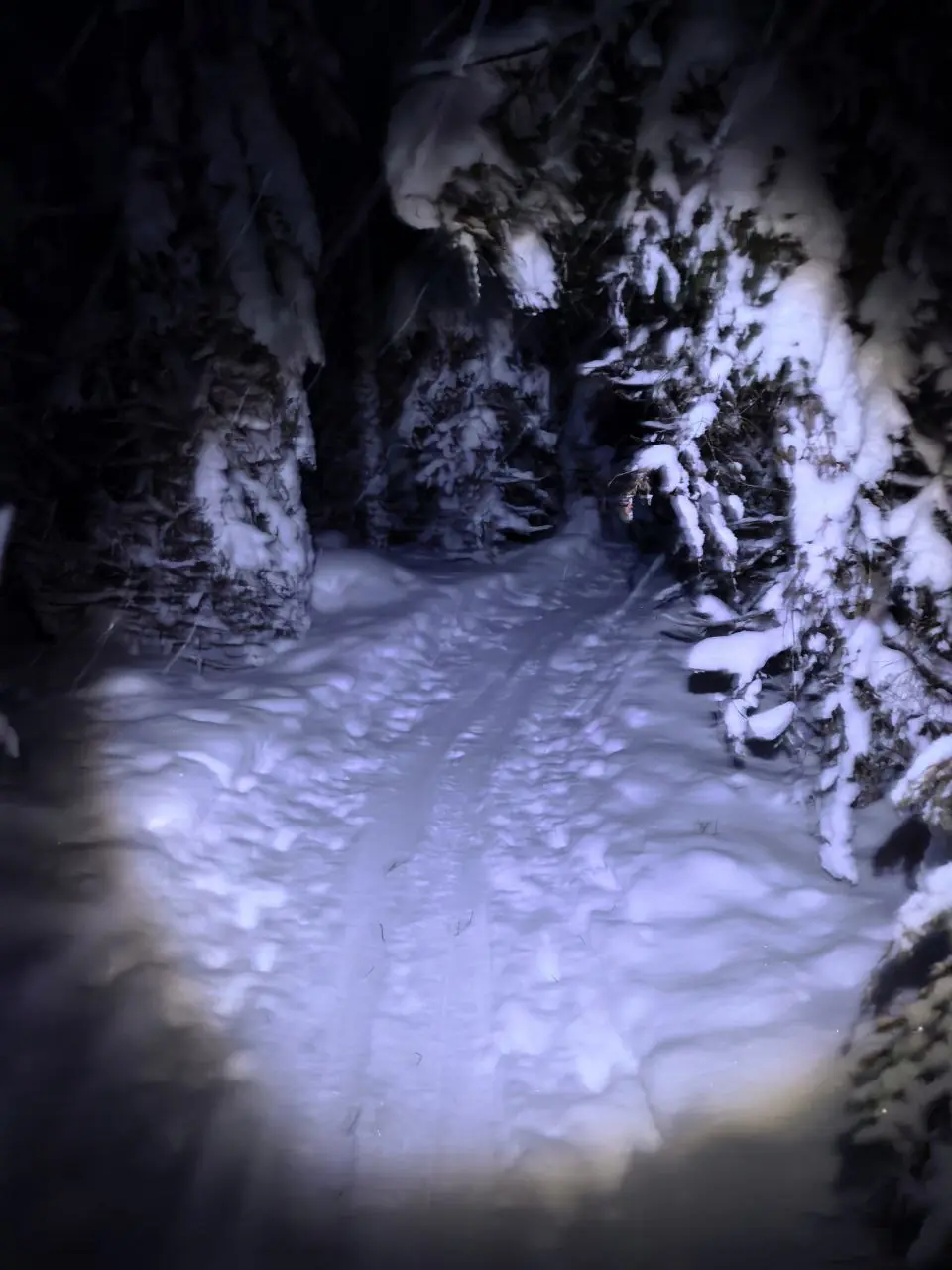
Third: treating darkness as “it will be fine”. In the forest outside the city it gets properly dark, and snow only makes the single road white inside the beam of a lamp. Without light any familiar trail becomes unfamiliar. A lamp is not about comfort, it is about whether you reach the platform or not.
A frozen lake in winter looks like a field, and that is a trap. Skis do not spread your weight across the ice: a person who goes through on skis goes under the water just like a person without them. There is no “wide surface area” on a cross-country ski. Walk around frozen water along the shore — it costs an extra few hundred metres, not a risk.
In winter the snow deadens sound, and you can barely hear an approaching suburban train. That is the main reason you must not walk on the tracks or cut along them. If your route comes out at the railway, look for the way to the platform instead of walking along the embankment.
Plan not just the way in but the exit point. Forest ski tracks often end where there is nobody around: beyond that it is either untouched snow or someone else’s clearing. Checking the map and fixing your exit in advance is cheaper than looking for it in the dark with wet feet.
In Orekhovo: marked loops of 5, 10 and 15 km, a cut track, signs on the descents. Entry is free and the grooming is funded by voluntary donations.
Lighting on trails near St Petersburg is a problem: in Orekhovo there is no light on the track at all, and at Ivanovskaya there are lamps on only part of the route. Plan on your own headlamp.
Yes, and it is the most interesting format: you start at one station, follow the route onwards and travel home from another. That is how the route at Ivanovskaya works, for example.
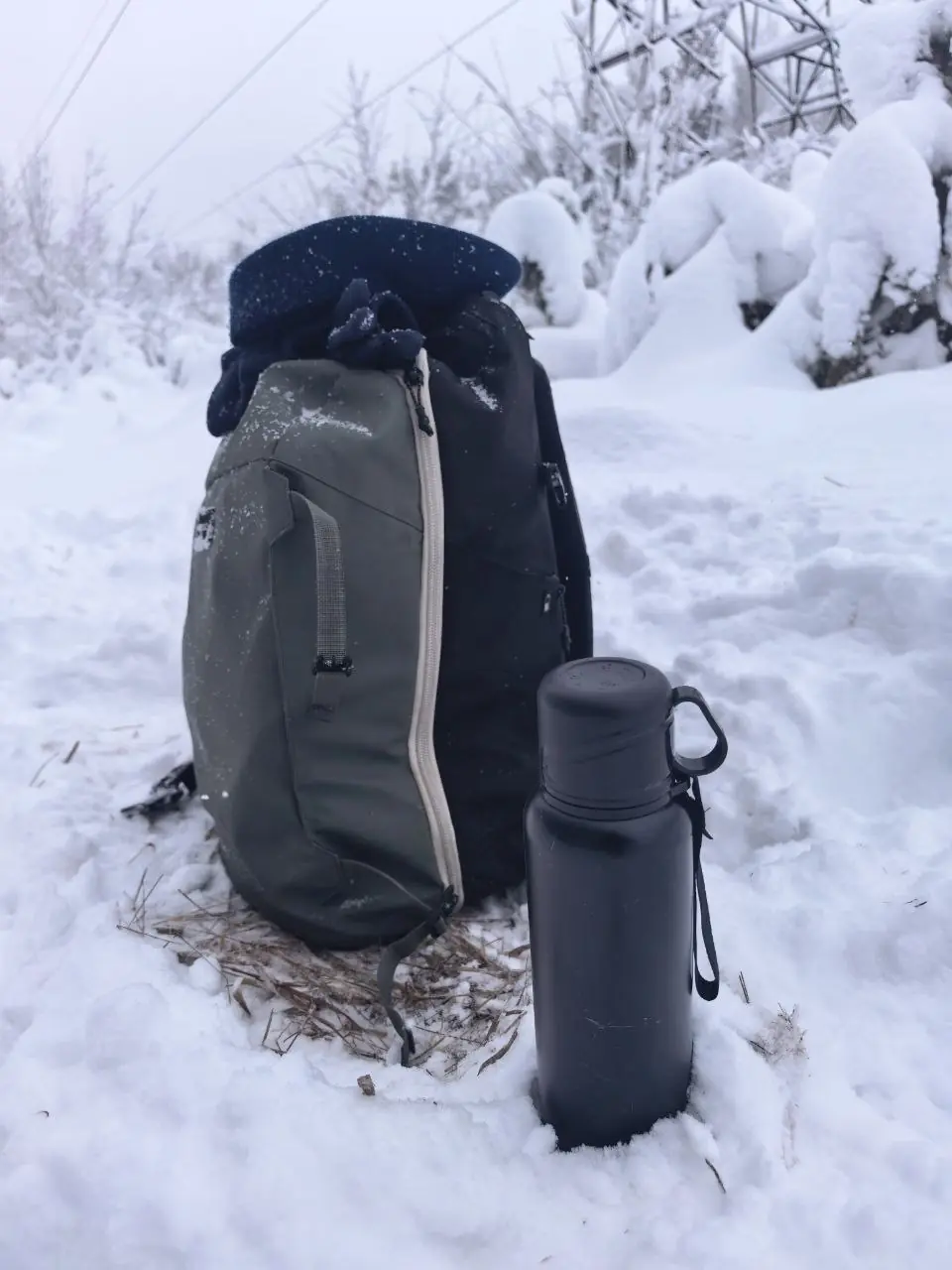
A thermos with something hot, a headlamp, spare socks and a map downloaded in advance — there may be no internet outside the city.
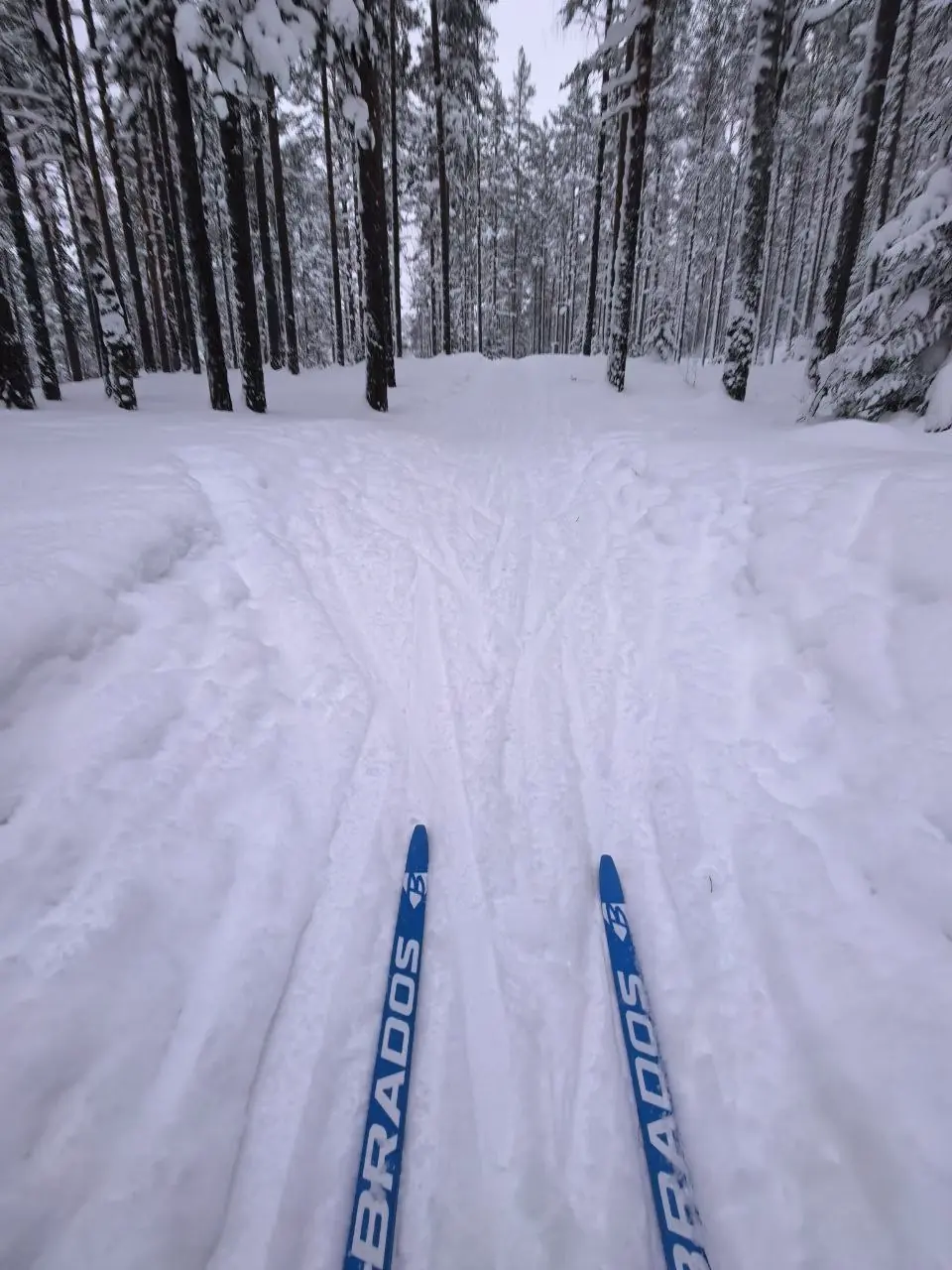
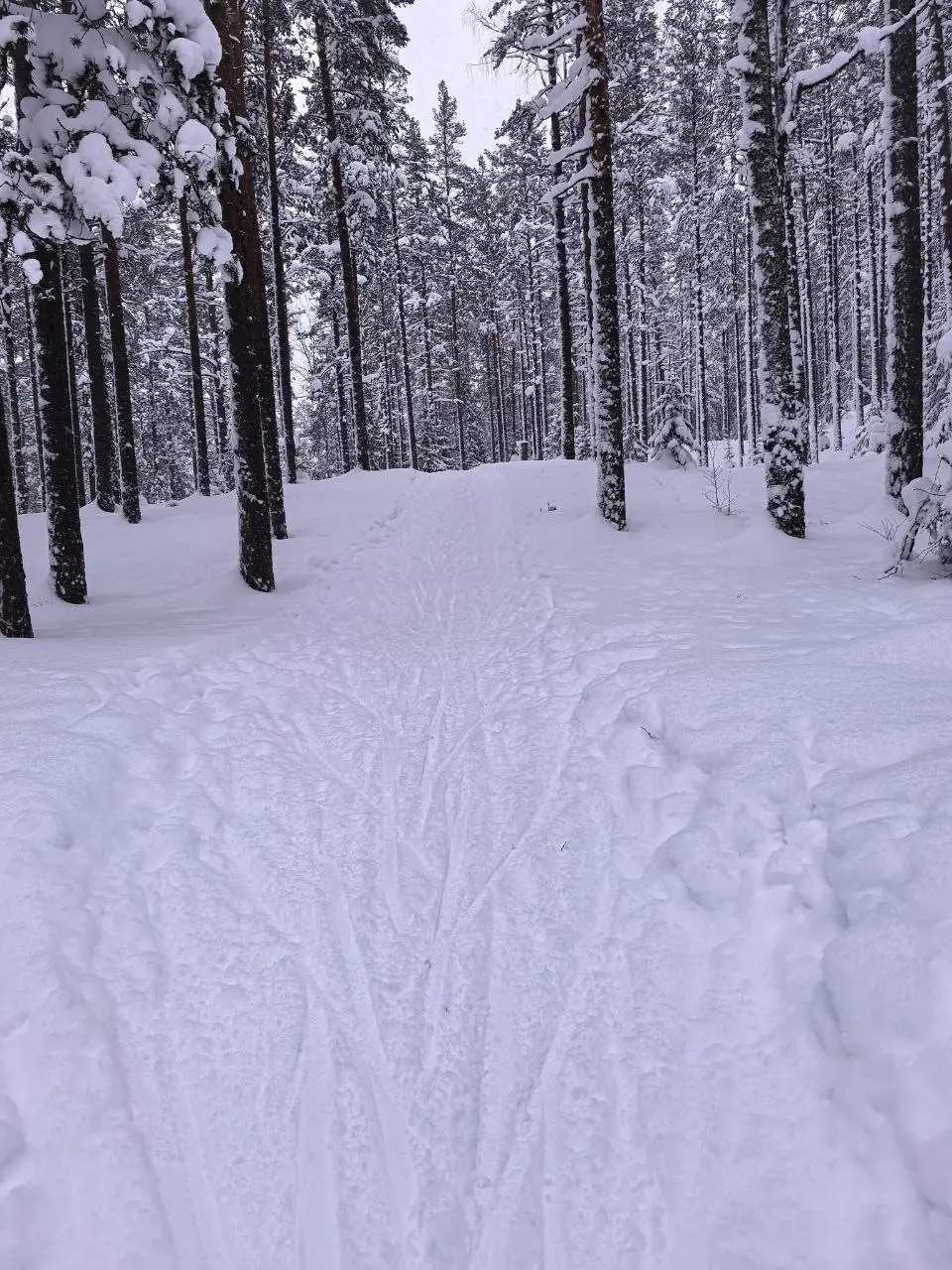
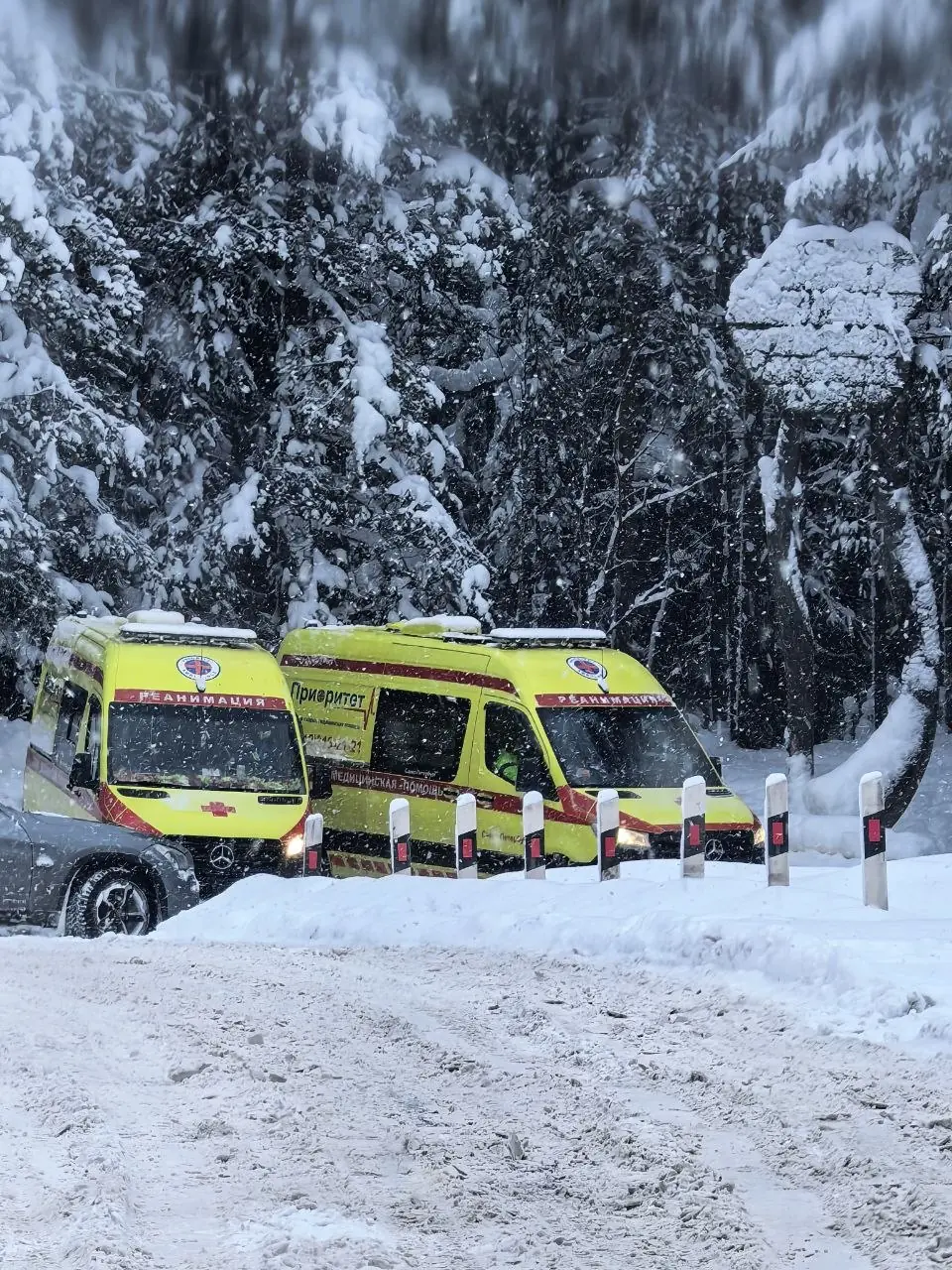
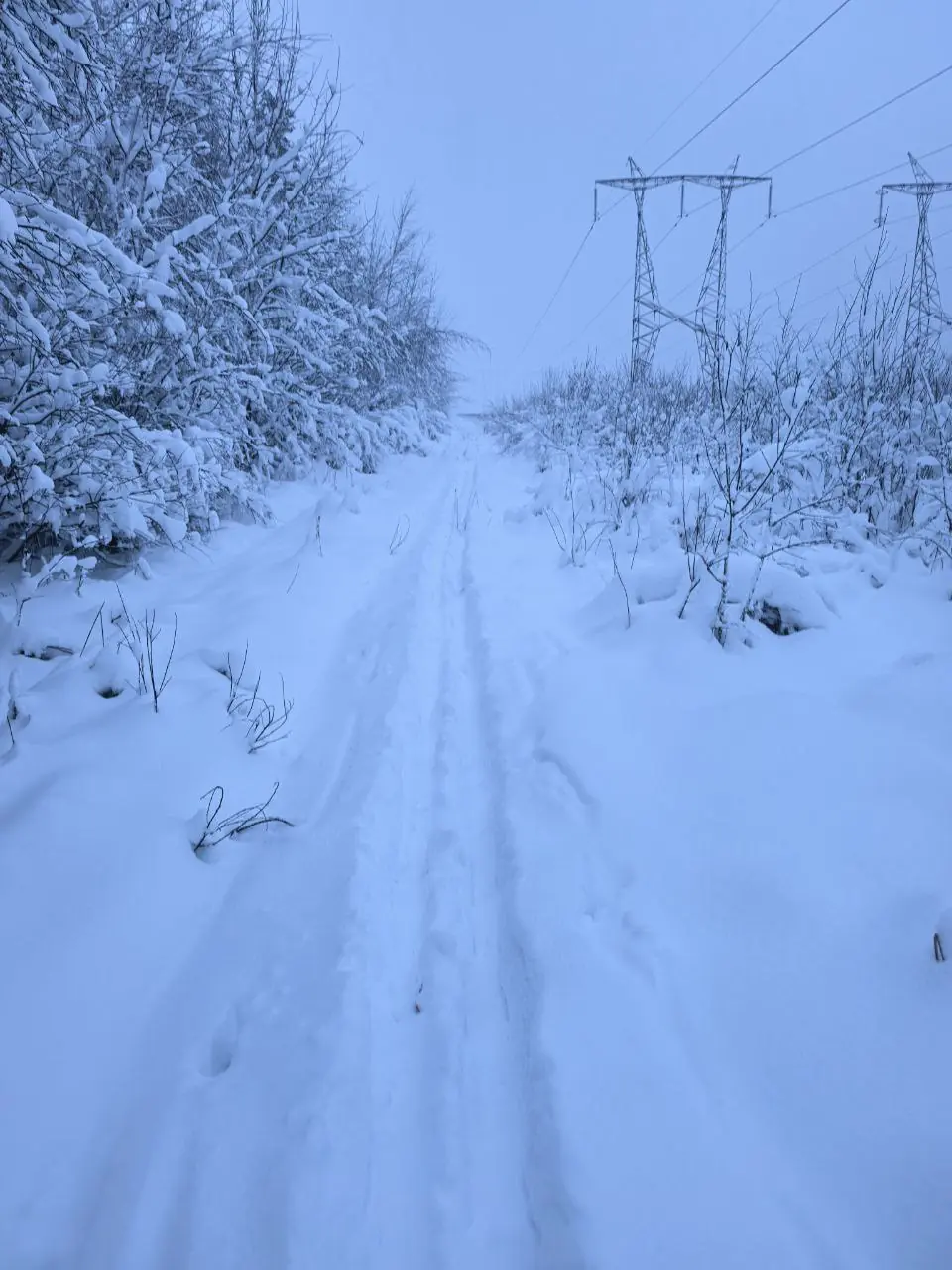
Below are shots from the two trips described above: the groomed Orekhovo trail with its loops and the forest labyrinth at Ivanovskaya. Click a shot to open it full size.