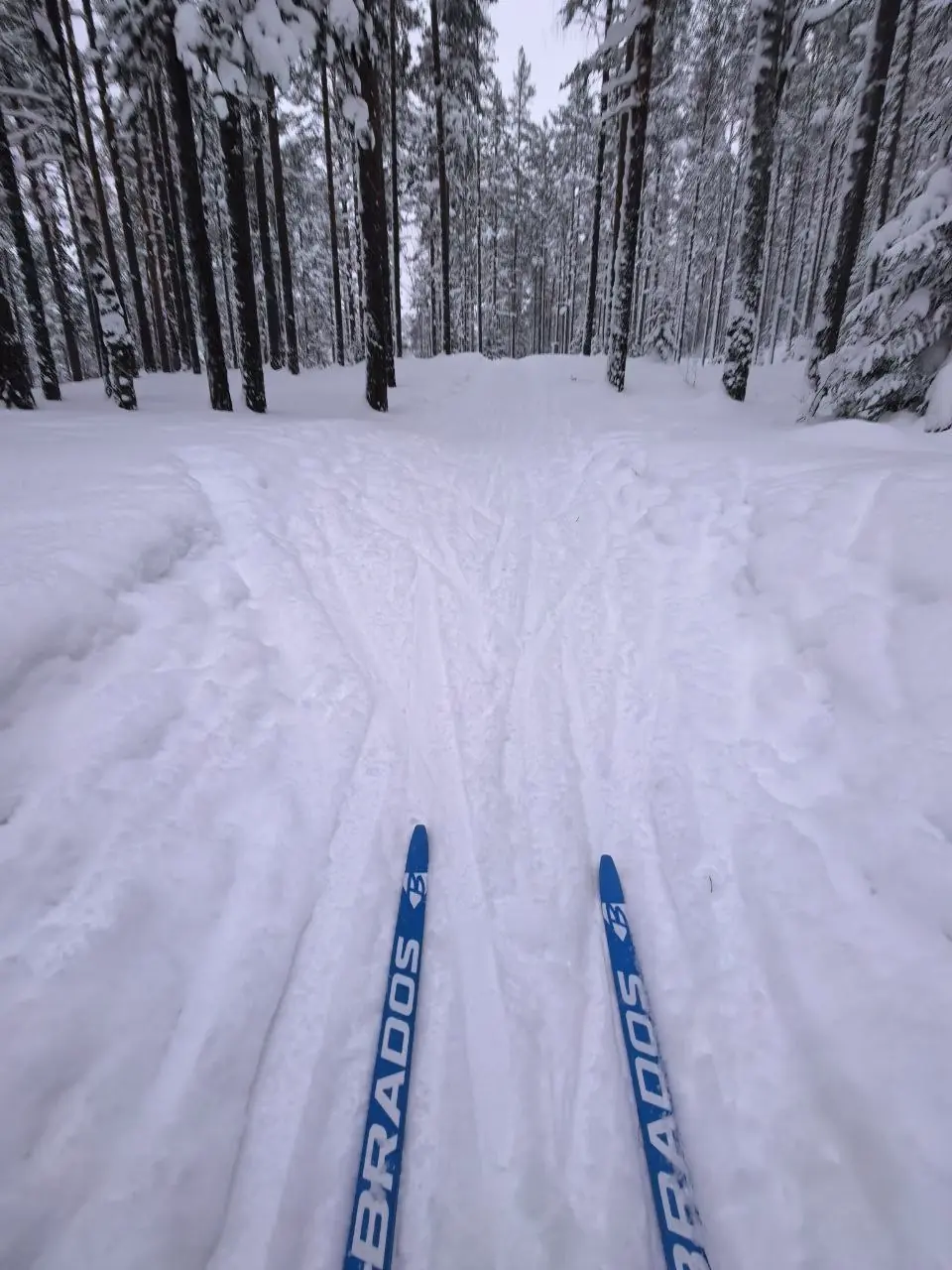
Orekhovo is a groomed trail with 5, 10 and 15 km loops and three lakes along the way. How to get there by suburban train and by car, where the trail starts, what it costs, and why you should never ski onto lake ice.
Orekhovo is one of the few places in the region where the ski trail is genuinely groomed: marked loops of 5, 10 and 15 km, kilometre markers, direction signs, start markers and signs on the dangerous sections. The trail is not a loop in the usual sense — it is more of a labyrinth: there are many entrances and exits, and in a single outing you can ski it a dozen different ways.
The trail is groomed with a snowmobile, and the state of the ski track shows it: on good days it is cut perfectly. You can ski the 15 km or the 10 km — the routes intersect.
The map for the 2025/2026 season shows:
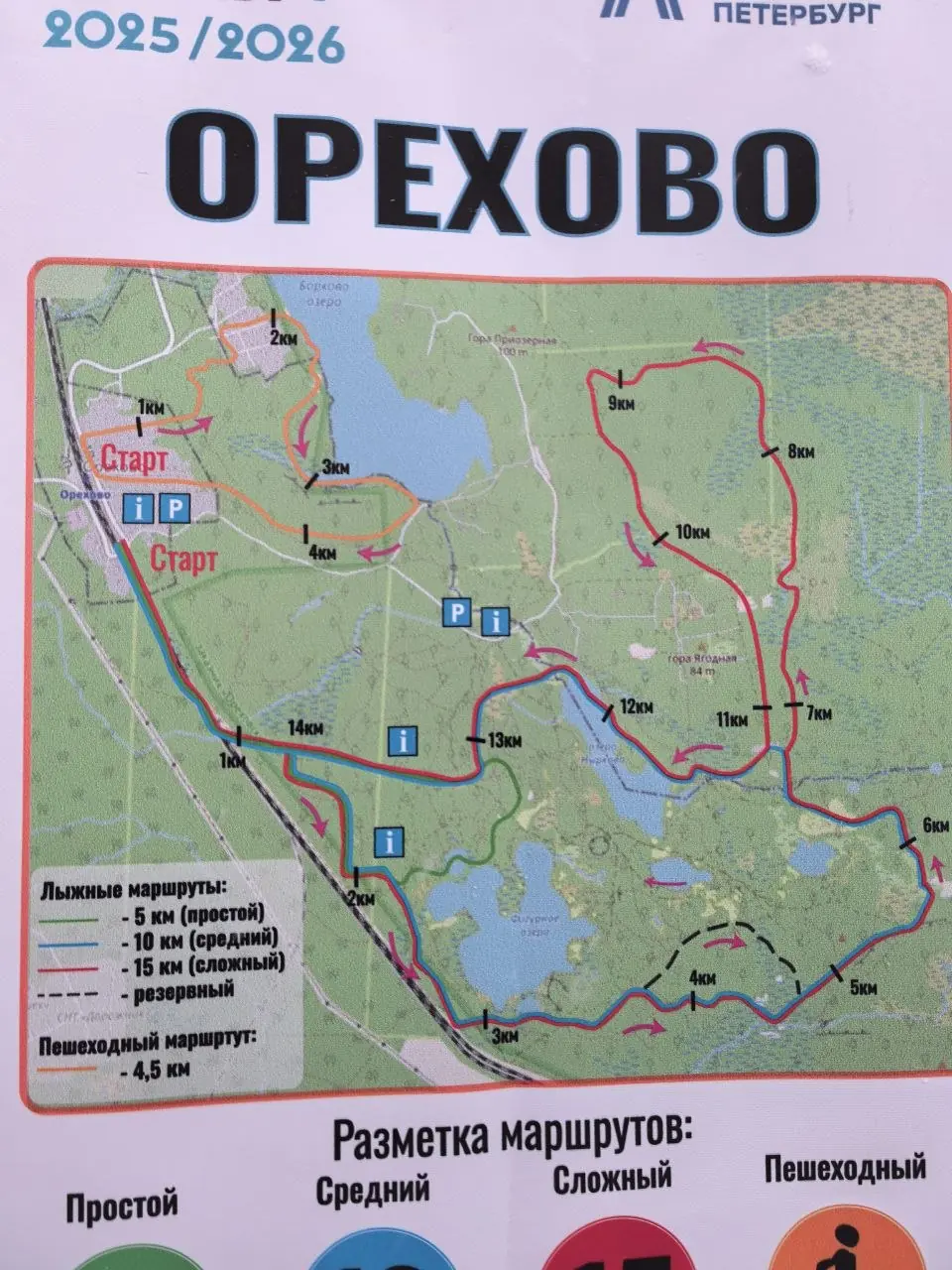
| Route | Length | Level |
|---|---|---|
| Green | 5 km | easy |
| Blue | 10 km | intermediate |
| Red | 15 km | difficult |
| Reserve route | — | dashed line on the map |
| Walking route | 4.5 km | for walks without skis |
The map also marks kilometres 1 to 15, direction arrows, and start and parking icons.
One detail worth knowing: the reserve route is a cut-through. It is not a separate trail but a short alternative passage between sections — like the service corridors in a shopping centre, when you do not have to walk through the whole hall. For a skier it means exactly one thing: you really can ski it in different ways. Tired of one loop — on the next lap you take the cut-through into another one.
The trail has elevation changes and interesting bends: if you ski at about 10 km/h, it is genuinely fun here. A skier who moves slowly and works on technique may find some sections narrow — in places it is not that easy to pass each other. Overall you can feel that the route was not laid out with a ruler, but with an understanding of how it should ride.
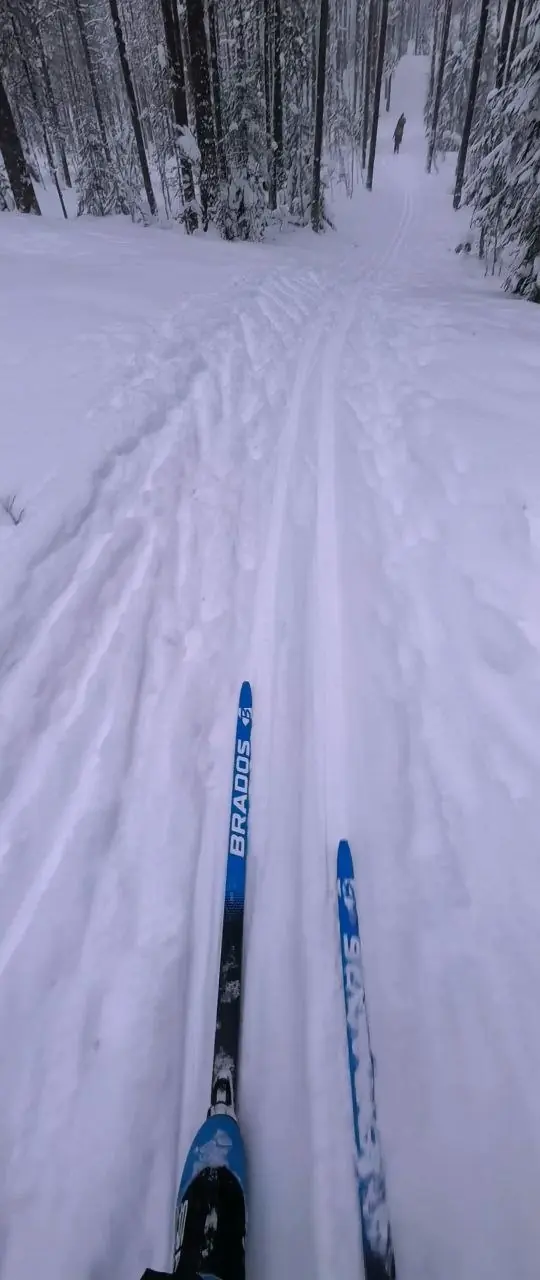
There are at least three lakes on the trail, and one of them really is shaped like a saucer: round and flat. There is a spot from which you can see everything around at once — you can stop, sit down, breathe out. According to the maps there is a lake nearby with a fitting name, Blyudechko lake — that is the one.
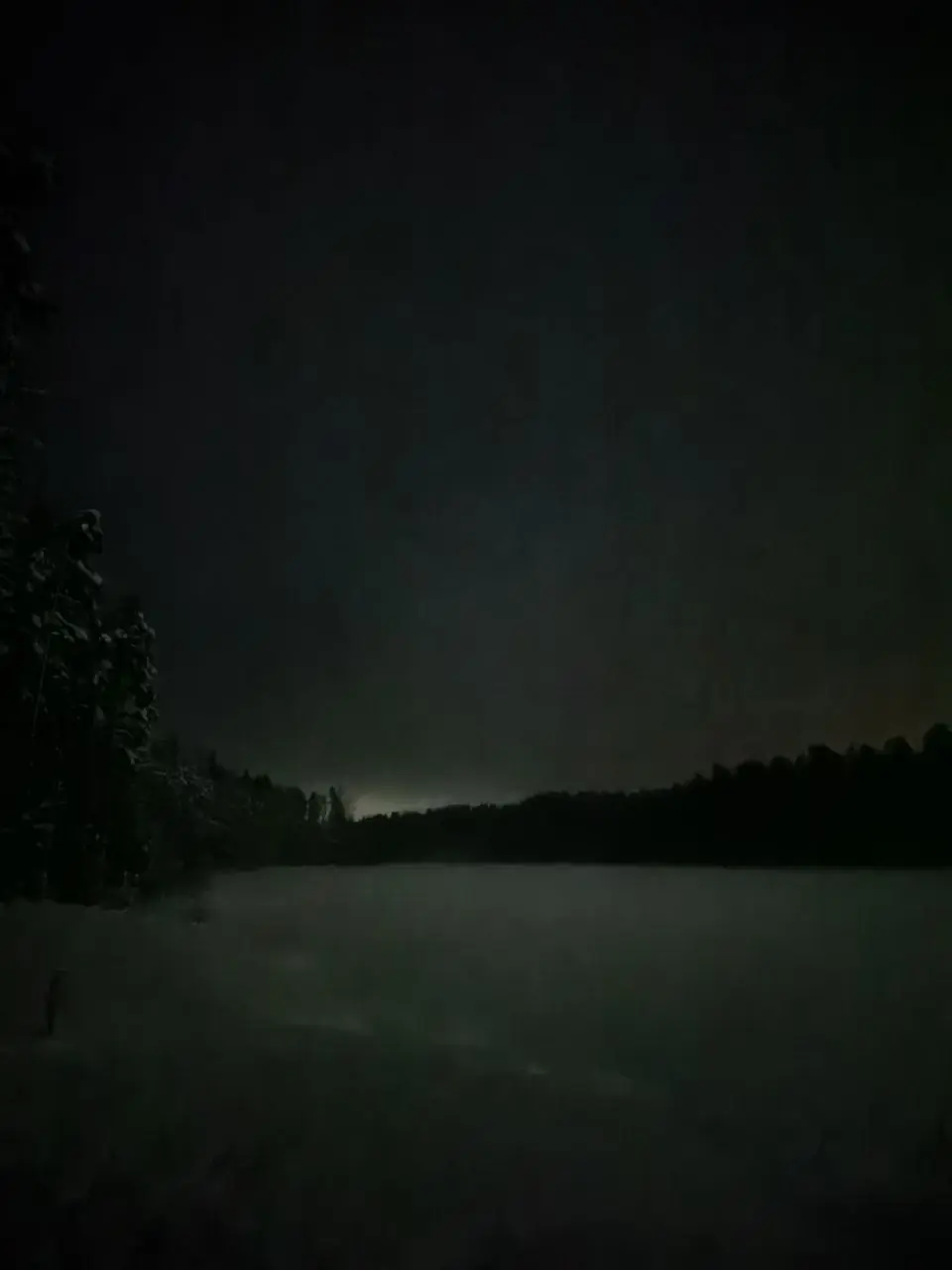
This is not a cautious recommendation but a firm rule. Skis do not spread your weight on ice. A person on skis who goes through goes under the water exactly like a person without skis — the skis will not save you. In winter a frozen lake looks like a field, and that is the main trap: a frozen body of water is not always visible, because the snow lies on top of the ice in an even layer.
What to do: go around water along the shore. You can ski a full circle around a frozen lake — the detour adds a little distance and no risk at all.
The trail has many entrances, and that is the fundamental difference between Orekhovo and an ordinary ski centre. If you have no car, aim for the suburban train: the nearest entrance is by the station, not far from the level crossing. It is about four hundred metres from the platform to the level crossing, and the ski track starts behind it. From there you can head straight into the depths of the forest, or walk a little way along the railway.
If you come by car, there are several entrances and exits too — look at the map before you set off, so you are not hunting for the turn in the dark.
By suburban train. Orekhovo station is on the Priozersk line, departing from Finlyandsky railway station. The journey takes from 56 minutes to an hour and a half, depending on whether the train stops at every station or not.
By car. From Finlyandsky railway station it is about 64 km, roughly an hour without traffic. You drive along the Sortavala highway, then turn right; after that the roads are awkward — they wind and loop. The advantage of a car is clear and obvious: after skiing you want to get straight into the warm, not wait for the train on the platform.
Entry to the trail is free. But the trail runs not on a ticket office but on people: in the group on VKontakte you can transfer money directly to the person who grooms it, so that he clears it more and makes it better. One adult skier pays 300 roubles a month — and considers it normal: the trail is cleared, the ski track is cut, you can ski all season. In a year he will still be using it. This way of supporting a trail is rare, and it is worth knowing about.
Important for planning: on the trail itself the lamps are not lit. They exist only at the entrances — municipal ones. That means an evening outing is entirely your own light: you need a headlamp. With one, skiing looks completely different: a bright spot runs ahead along the ski track and the forest around is black. We have a separate article about night outings.
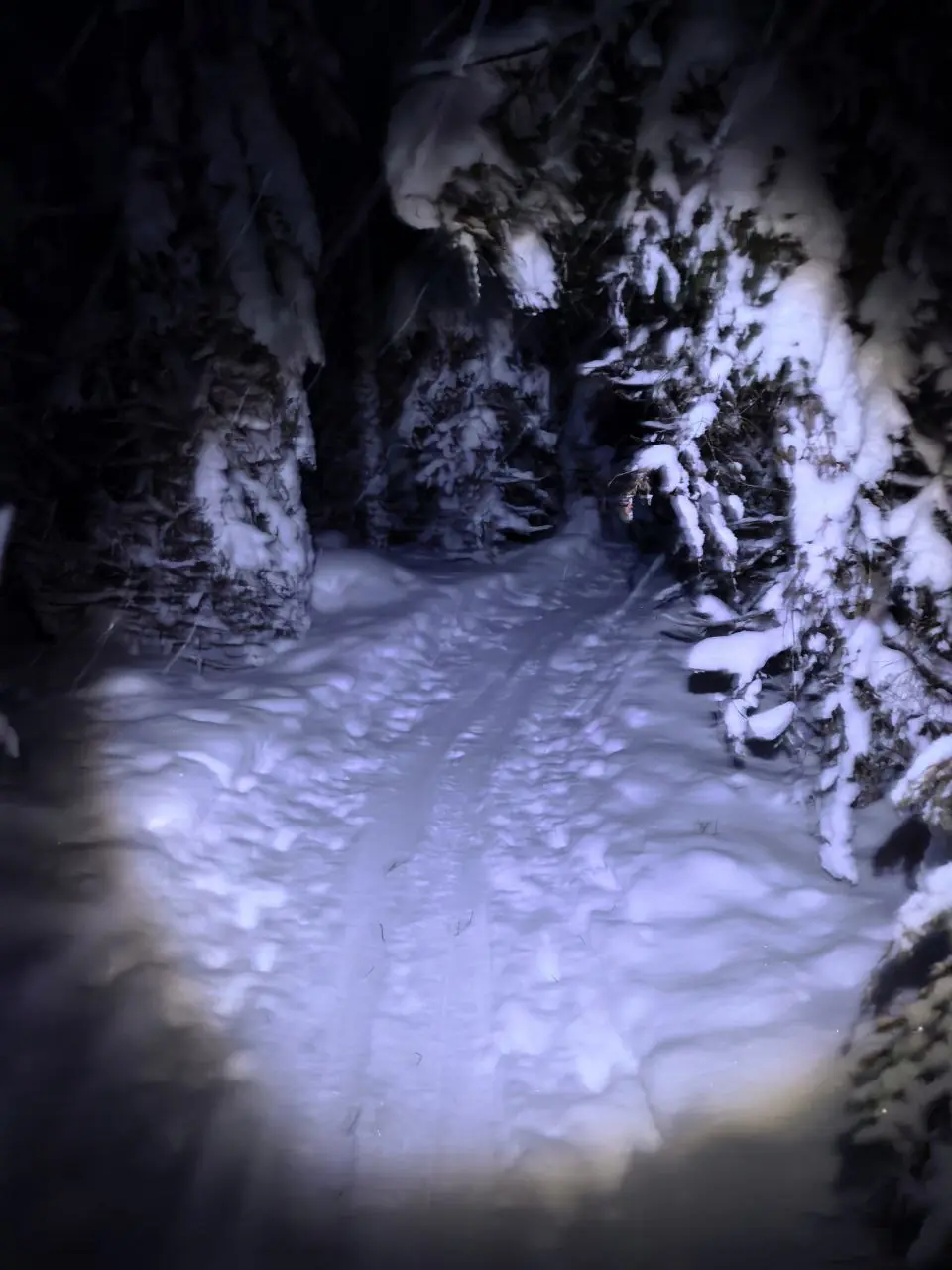
At night it is the lakes and the open sections that help you find your way, while narrow sections are better taken calmly in the dark: the terrain here has elevation changes.
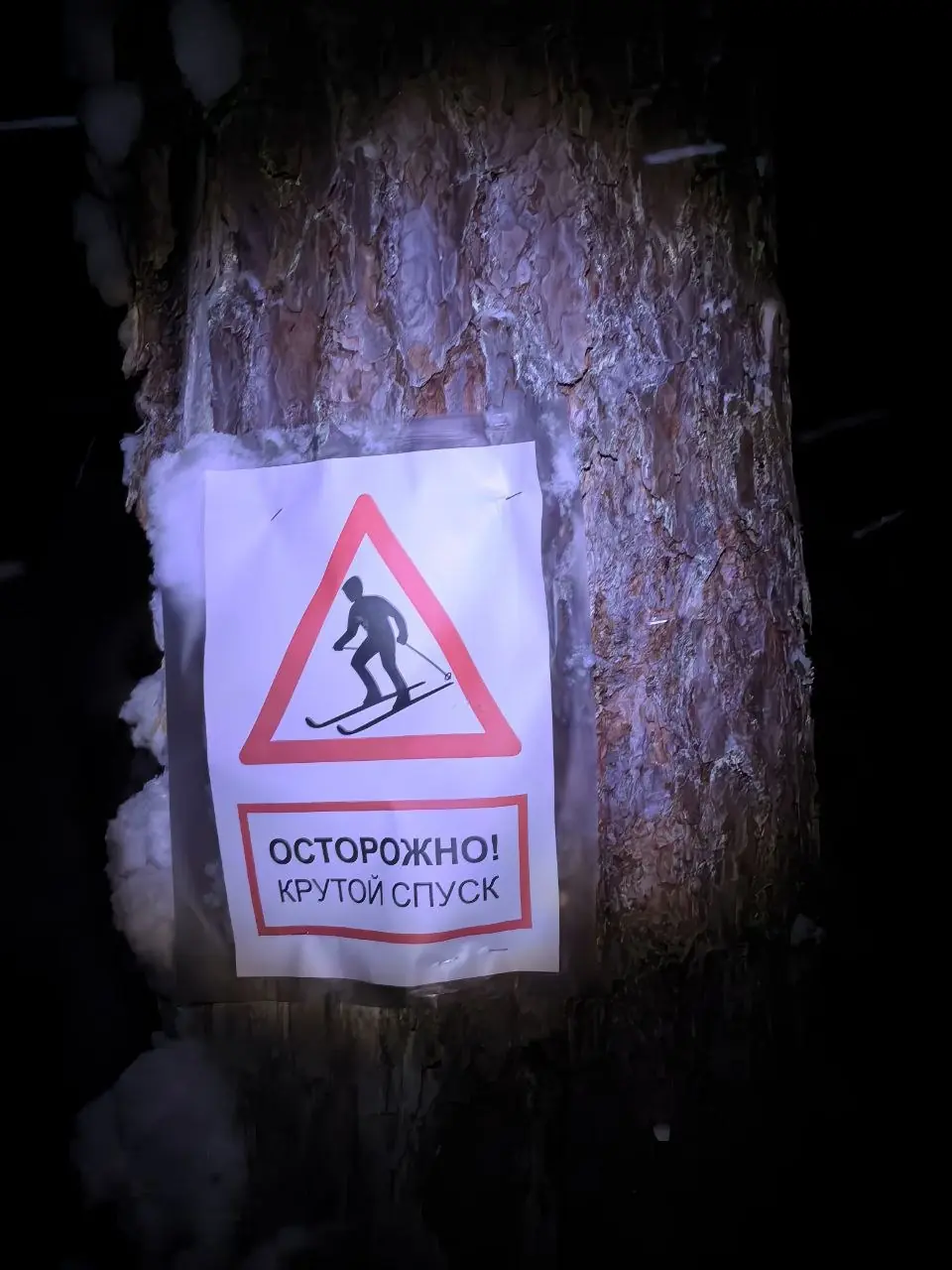
There are "Caution! Steep descent" signs along the route, with a diagram of a skier. So the descents do not simply exist — they are marked, and that is a sign of a trail groomed by someone who knows what he is doing. The sign is an instruction to slow down in advance, not at the moment of the descent.
You cannot walk on the ski loops: this is a ski trail, and pedestrians ruin it — they sink deeper and break up the surface. For walks the map has a separate 4.5 km walking route. Sledges are not an option either: the area is set aside for skis.
The rule is simple and honest: if you want to walk, take the walking route. If you want to ski, get on your skis and stay off the ice.
Orekhovo is not only about skiing. Nearby are the Orekhovo nature reserve, the route from Orekhovo to Ladoga and a photo archive of these places:
Entry is free. You can support the grooming of the trail with a voluntary transfer to the person who makes it — a common practice among those who ski here regularly.
No. The lamps are only at the entrances. For evening skiing you need a headlamp.
No. You must not go out on the ice on skis: skis do not spread your weight, and you go through just as you would without them. Go around bodies of water along the shore.
Yes, it is one of the most convenient options: Orekhovo station is on the Priozersk line, 56–90 minutes from Finlyandsky railway station. From the station to the nearest entrance to the ski track it is about four hundred metres to the level crossing.
Not on the ski loops. For walks the map has a separate 4.5 km walking route.
The lakes on this trail deserve a word of their own, because they are its decoration and its main trap. Looking at frozen lakes is beautiful, while the feeling of standing next to open water at the edge is something else entirely: the ice cracks and gives way under your weight if you step onto it.
It has a sound of its own, and some people find it entertaining. But the rule is simple and without exceptions: you must not go out on the ice on skis — neither on new ice nor on ice that "already holds". Skis do not spread your weight the way it needs to be spread, and going through the ice is considered equally deadly for a skier and for a person without skis.
The route is very scenic thanks to two things — the terrain and the lakes. There are elevation changes, but small ones, on the order of 30–50 metres: now you drop down a little hill, now you climb the next one. The trail has some quite interesting twists as well as long straight sections.
The monotonous work with the poles switches your head off at the same time: on the long sections you fall into an even rhythm, and that is probably the most pleasant effect of an hour-long ski session. Also on the physical side: power and clear skate sections are not everywhere, and you do not have to ski the whole route without stopping.
Their shapes differ, and that is part of the pleasure too: one of the lakes is round and flat like a pancake, the other is elongated — melon-shaped. Because of this the route does not turn into a monotonous loop: now the open expanse of frozen water, now the forest again.
Two completely different routes lead to Orekhovo.
By car — about 60–70 kilometres along the highway, and the drive takes around an hour and a half. The obvious advantage: after a ski outing you get straight into the warm. That is exactly why I usually went by car.
The second way is the "ski special train", which carries skiers specifically to this ski track. It is a retro train from the 1980s — it sounds great and becomes part of the outing in itself. If you are interested not only in skiing but also in arriving with some character, this option is better.
Another thing you realise once you get talking to the locals: this ski track is part of a long cycling and walking trail, and along it you can go far beyond the surroundings of Orekhovo. The routes here are such that in a day you can reach Lake Ladoga: it is a long walk, and sometimes you can even go out onto the water.
The loop around Orekhovo is only a short part of that network. What exactly is out there is covered separately in our article about the route from Orekhovo to Ladoga.