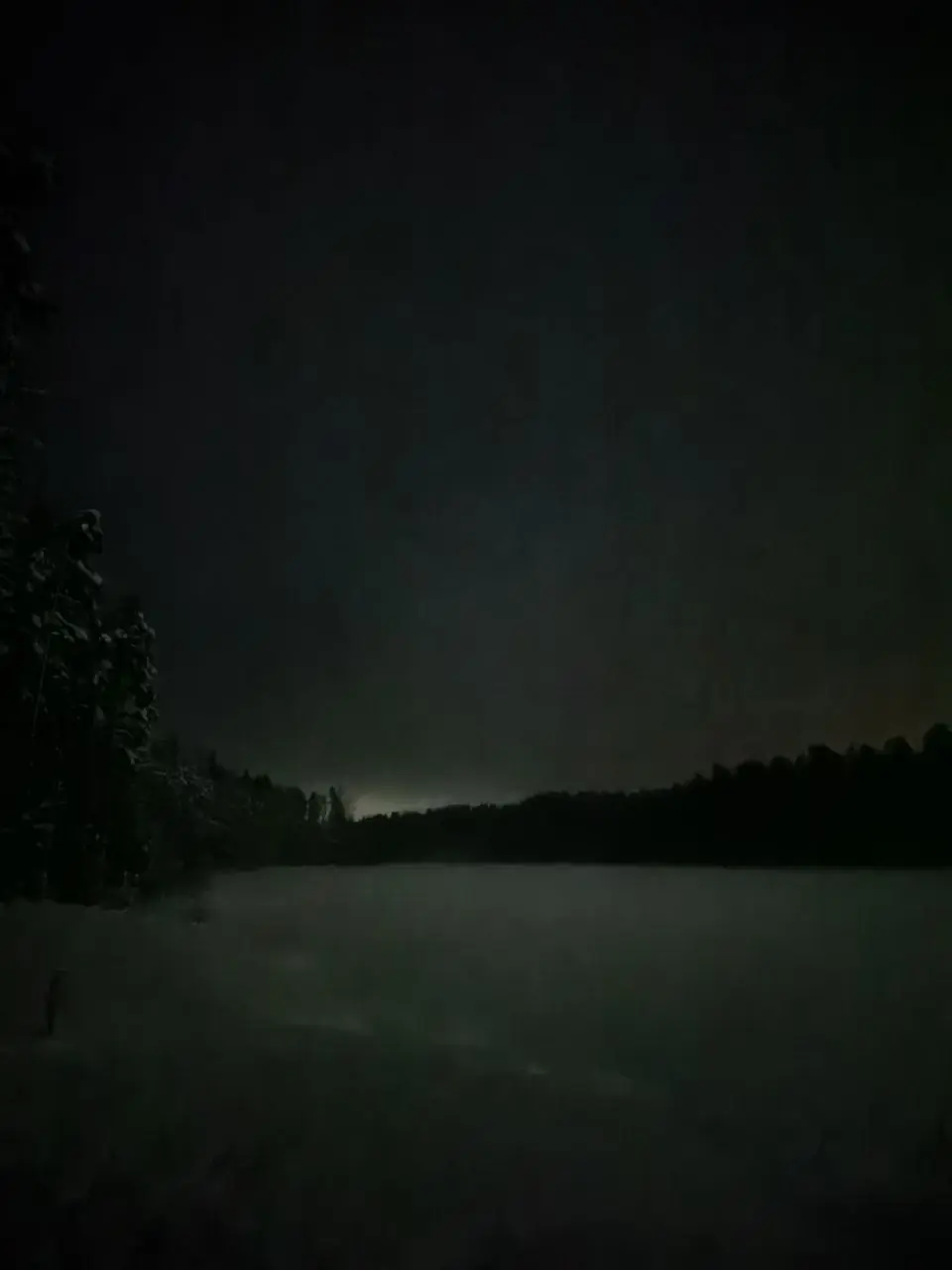
How to ski in the dark: what you need besides a headlamp, how a night trail differs from a daytime one, what a winter night adds to the risks — and what it feels like to have the track to yourself.
Night skiing is not about records. It is about a different state: the trail is empty, the forest is black, and the only thing you can see is the patch of light from your headlamp moving ahead along the track. In daytime you ski that same track among people, snow and grey light. At night you are left alone with it, and the very same trail feels completely different.
There is a particular pleasure in waiting for the suburban train with all its people to leave, and staying on the trail alone. At that moment the darkness does not matter — you are ready, you set off and you go. In daytime people ski this same track, talk, overtake you; in the evening what is left is snow, a headlamp and you.
You go and the snow flies into your eyes. It does not get in the way and it is not annoying: you move meditatively, evenly, at your own rhythm, and your head finally empties out. That is exactly what people come out into the dark for, and not for the kilometres.
Then the trail runs under a power line, and the strangest part begins. Along the power line you end up in a kind of acoustic vacuum: the monotonous hum of the wires overhead, the rustle of snow under your skis, and not a single other sound around. As if you were inside a sphere that the outside world cannot reach. The feeling is alien and pleasant at the same time — but only while it does not last long; after half an hour the steady drone starts to press on you and you want to get out into the open.
Sounds come one at a time at night, never together: either complete silence, or a plane passing overhead, or the power line humming. There is nothing else to make a sound in a winter forest outside the city — no people, no machinery, no birds.
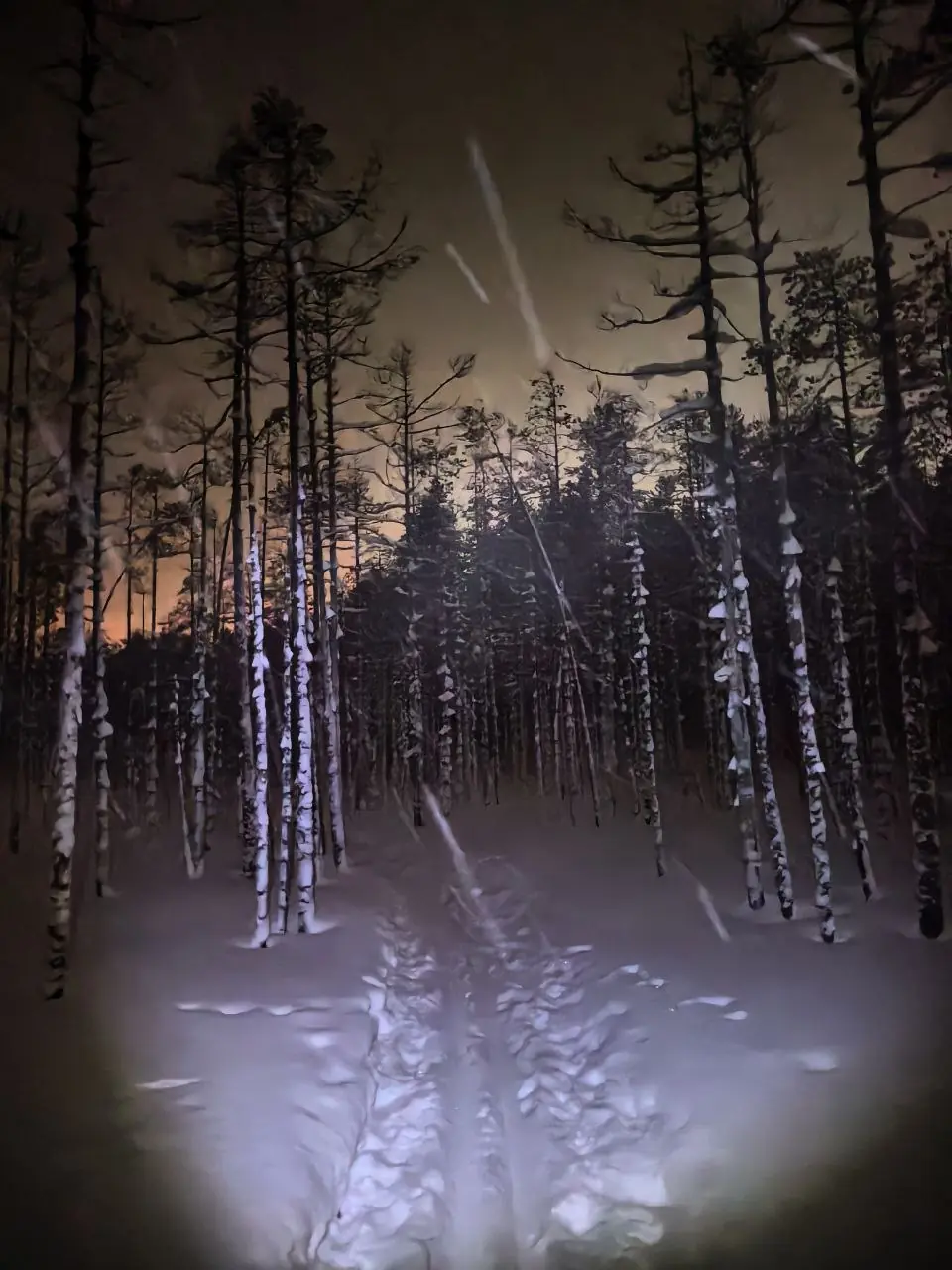
And one more thing that does not happen on a popular trail: emptiness. Ten minutes — not a single skier. But you do see what is hidden by movement in daytime: fresh snow on the branches, tracks that nobody crossed before you, and a lake off to the side of the track — a dark spot on white.
There is a practical point too: in winter it gets dark early, while the working day ends late. Getting to the forest before sunset does not always work out, and an evening trip is the only way to ski on a weekday. The last suburban train back to the city leaves already in the dark — and that way home is part of the experience in itself.
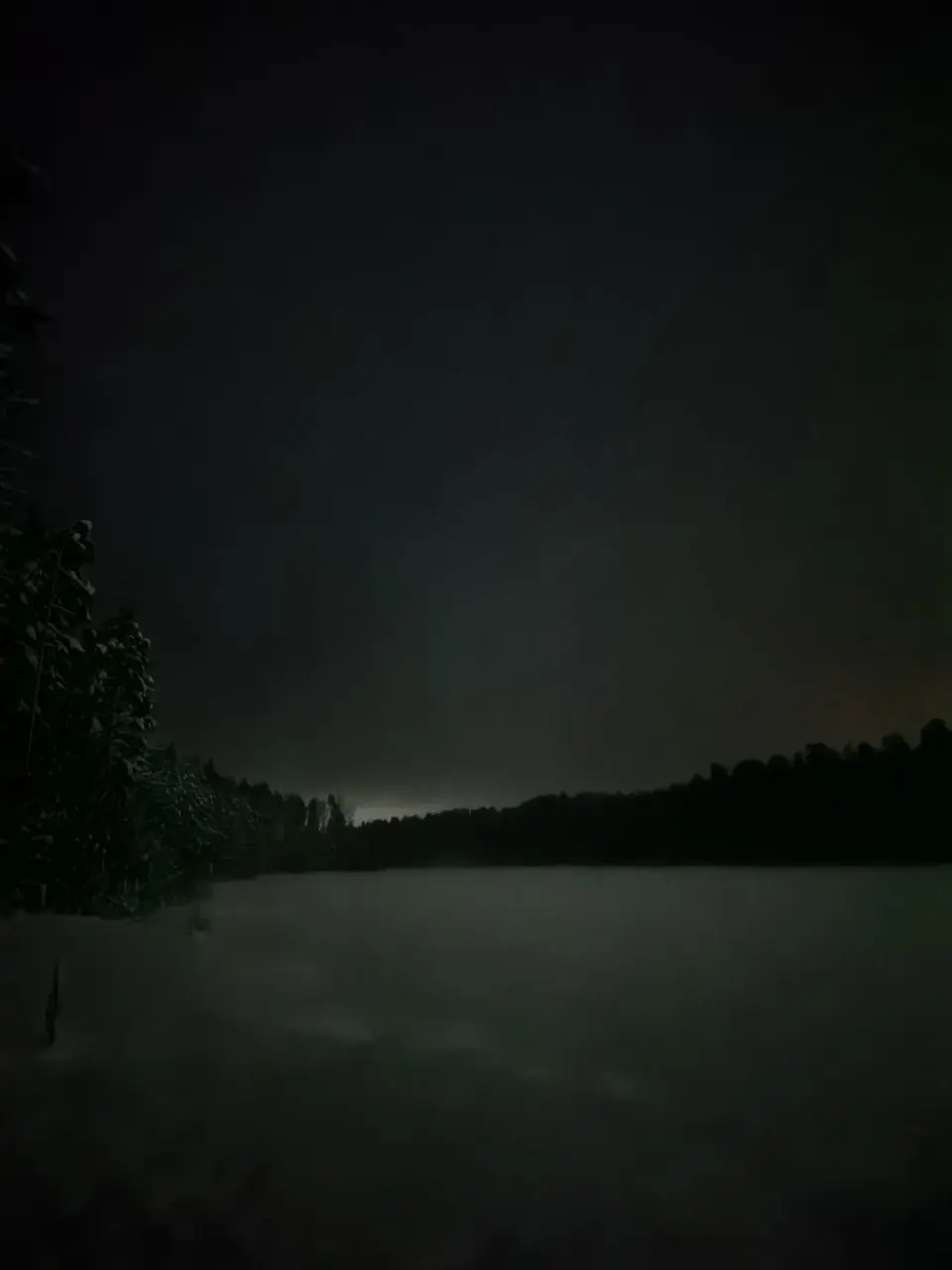
Without a headlamp night skiing does not exist. And here it is important to understand the difference between the trails.
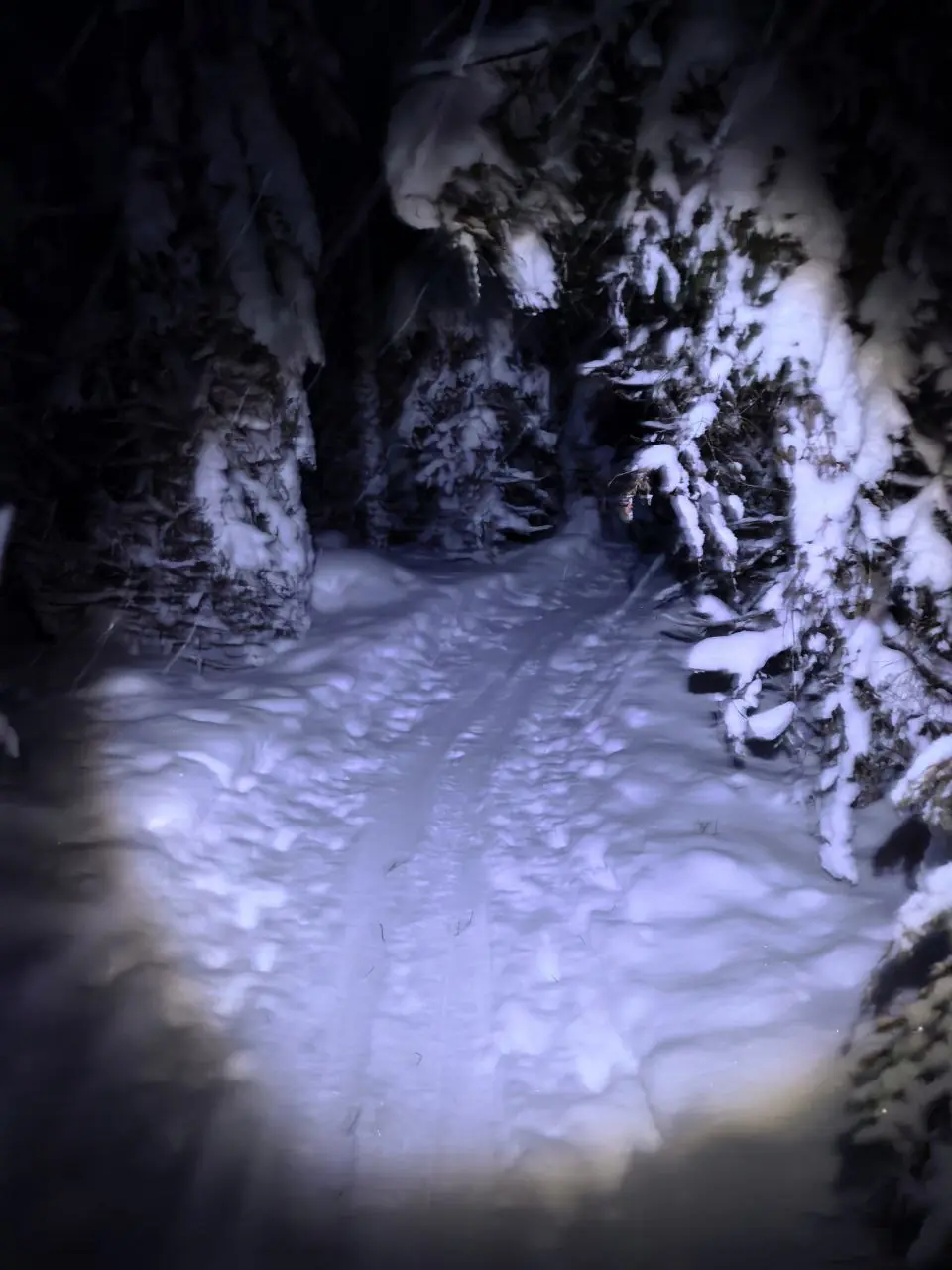
At Orekhovo there is no lighting at all on the track: lamps stand only at the entrances, they are municipal, and no light from them reaches the trail itself. At night the light is entirely yours.
At Ivanovskaya there are lamps, but not everywhere: part of the route is lit, part is completely dark. On a trail like that the changes in lighting throw you off your rhythm more than total darkness does: your eyes do not have time to adjust.
In Kirovsk (that is Murmansk Oblast, the Khibiny Mountains) the trail is genuinely lit — the first few hundred metres run under light, and that noticeably changes how the outing feels.
The conclusion is simple: always take light with you, even if the trail is described as “lit”. A headlamp is more convenient than a hand torch: your hands are free for the poles, and the beam points wherever your head turns.
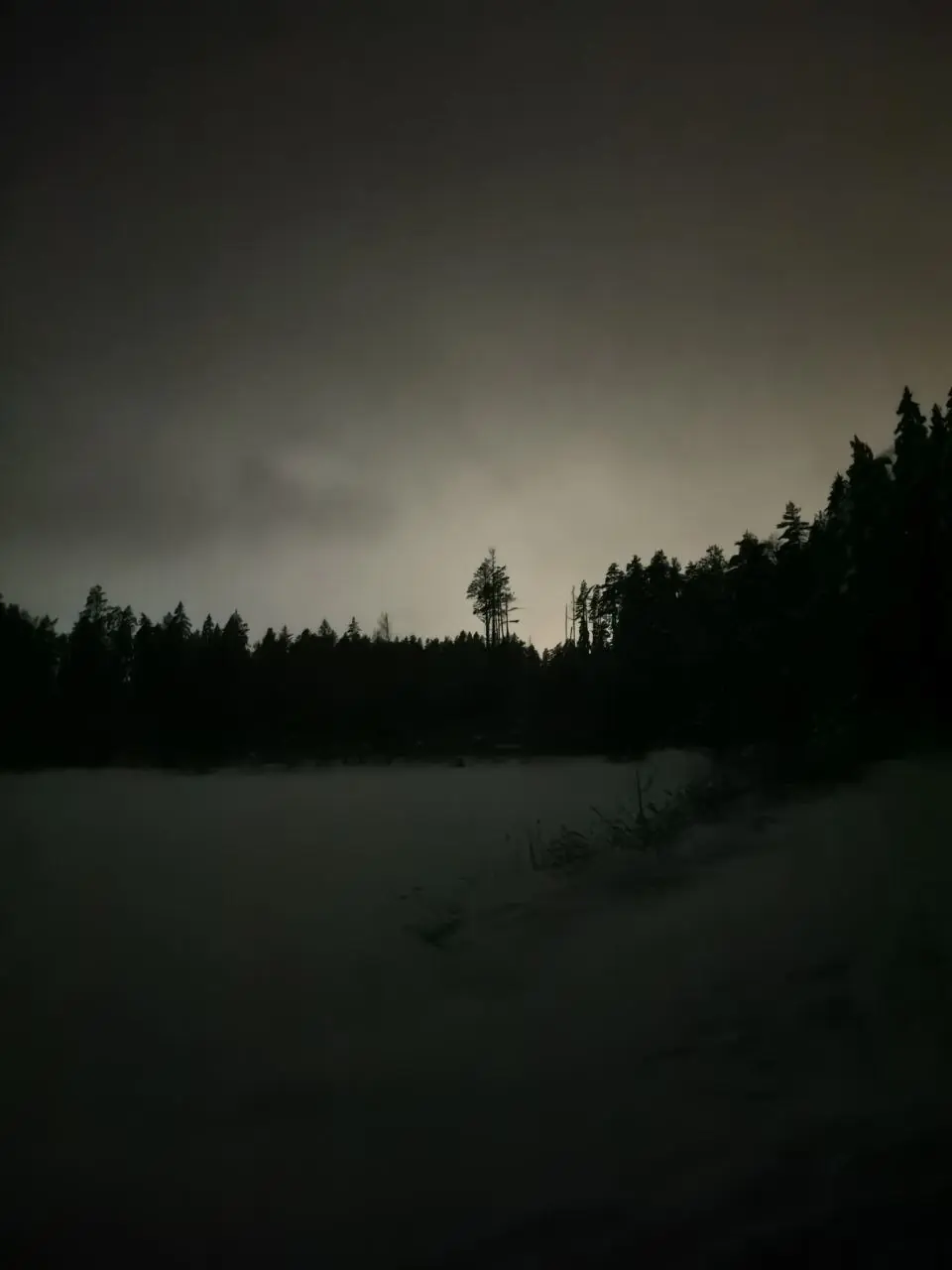
The best window is dusk and the first hours of darkness: the forest is still recognisable by its silhouettes, while the trail is already empty. Full moonless night is nothing but the patch of your headlamp, and for a first time that is a serious test.
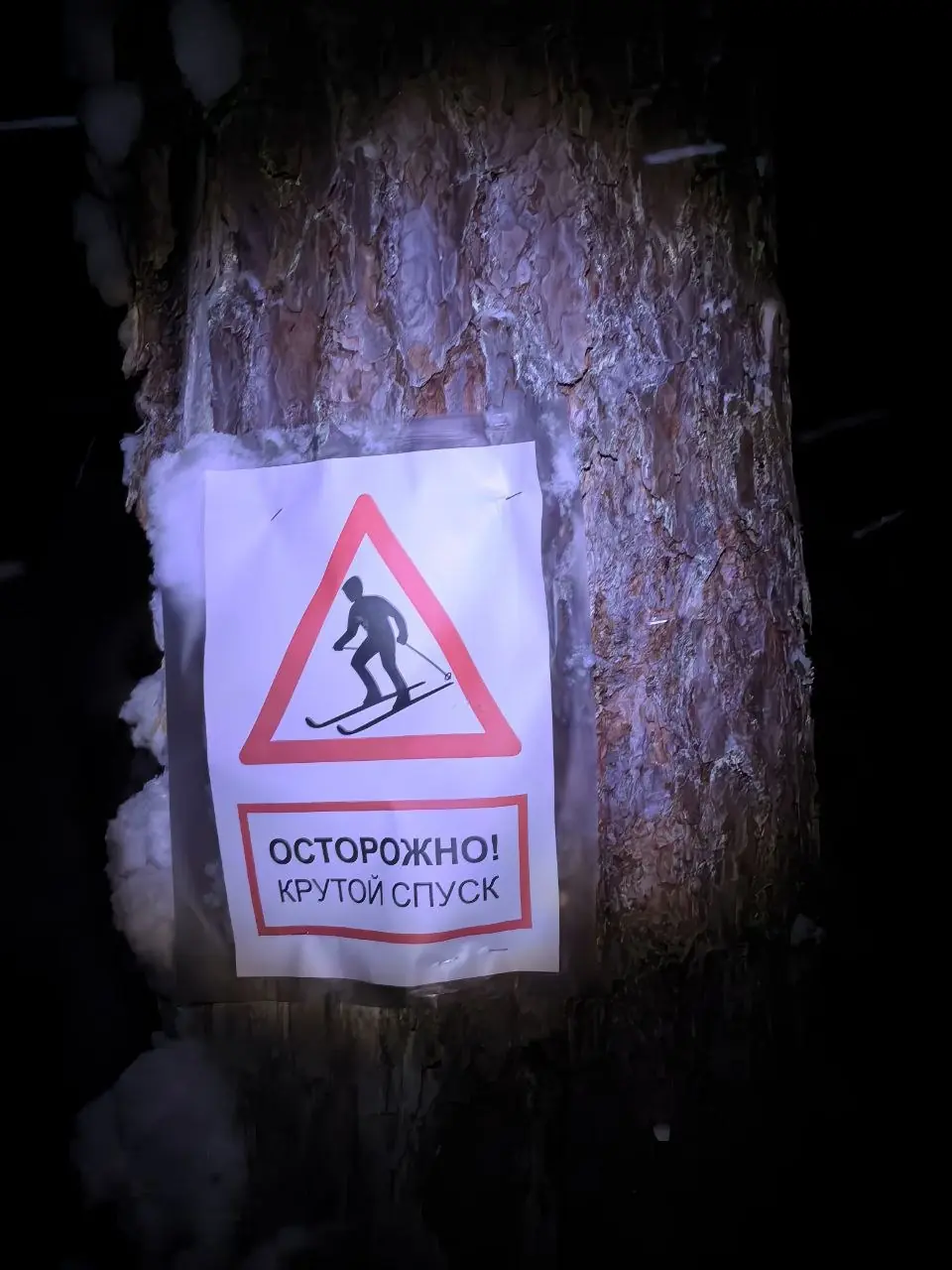
How long it lasts: aim for two hours of skiing — longer in the dark is usually unnecessary, and besides, clothes wet from snow cool down fast in the cold. And be sure to check and remember the times of the last suburban trains: the way back in the dark with no train is not an experiment worth running.
At night a frozen body of water is practically impossible to tell from a field — in daytime the relief of the shore gives it away, at night you cannot see it. You must not go onto ice on skis: skis do not spread the load, and you go through just as fast as without them. If the track heads out onto a flat expanse — turn around and go round along the shore.
In winter snow deadens sound: you cannot hear an approaching suburban train. At night there is the added fact that you cannot see it until the last moment either. That is why a night route should never depend on walking along the tracks — only alongside them, and only as far as the platform by the proper exit.
In daytime power lines, lakes and forks work as landmarks. At night the only landmark is your headlamp and the map. If you have doubts that you will find the way out before the last suburban train, do not start: this is exactly the case where the sensible thing is to ski less.
For a first night outing the best option is a familiar, prepared route that you have already skied in daytime. Then you know exactly where the descents are, where it is narrow and where to get out. The trail at Orekhovo suits that job: clear loops, marked descents — and a complete absence of light on the track, so the whole evening runs on your headlamp alone.
If you want real silence and a long route, look at the forest labyrinth at Ivanovskaya, but there is an important caveat for the night there: the track ends about a kilometre before the railway, and that stretch has to be walked through untouched snow. In the dark — only with a headlamp and a clear idea of where you are going.
Yes. Lighting is often only on part of the route: at Orekhovo there is no light at all on the track itself, at Ivanovskaya the lamps are not everywhere. You always need your own light.
A headlamp: your hands stay free and the beam points where you are looking. Take a spare one — small, in your pocket.
The main dangers are the same as in daytime, but you see them worse: ice on bodies of water and the railway, where you cannot hear a train because of the snow. Ski a familiar route with a headlamp and a map.
A headlamp plus a spare, a thermos with something hot, spare socks and a dry layer of clothing, a map downloaded in advance and a charged phone.
The first thing you notice is that visibility narrows to the nearest 10–20 metres. Beyond that your eye no longer makes out the details: something is there, but what exactly is unclear. You will not find a landscape like this in the city simply because there is too much light there: streets, windows and lamps do not let the darkness become real.
At the same time the forest is brighter than it seems. Moonlight, coming through even thick cloud, is enough to make out the track and find your way without a headlamp — that is exactly why night trails feel “like your own”. But you still need the headlamp: not so that you can see the track, but so that you can be seen, and so that you can catch whatever shoots out from under your feet on a descent.
There is a separate feeling — being abandoned. You feel that for a while you have left civilisation behind: ahead of you only the track, behind you only your own trail.
The first half hour to an hour feels brisk. And then, once you have put in a couple of hours in the dark, you start to feel a little paranoid — and that is a normal reaction, not a sign that something is wrong with you.
Your eyes and ears adapt to the fact that nothing is happening in the forest, and start reacting to every little thing: glints of snow look like movement, and the sound of a thermos knocking about in your backpack sounds like somebody’s footsteps. If something flies past behind you, it is most likely a bird. But in the dark your brain offers another version first.
Then the second wave comes, and it is a pleasant one: a feeling of calm. Your mind understands that you are in a dark forest, far enough from civilisation, and that here there is nothing you have to be on time for — you can simply put yourself back in order.
And then comes the thing I go into the forest in winter for: the feeling of being a prehistoric inhabitant, who can see 300 metres and has ended up somewhere where there is nothing at all (though there is internet, by the way). In the dark every action has consequences and shows itself at once: a binding breaks — you walk; you get cold — you fall ill; you sweat — you freeze. Nothing can be put off, and that brings you back into the “here and now”.
In the dark it is not only your sight that changes, but your hearing too. There are no loud sounds — there are many sounds: falling snow, swaying branches, the occasional skier, a plane overhead. And the main one of them is the wind. Not “wind in general”, but wind with a direction and a speed: you can adjust your clothing by it without taking your gloves off.
Something similar happens with perception: everything shifts into microtones. There are no large bright objects — there is the very dark and the very dim, and you begin to tell them apart. Above a birch grove, for instance, you can see a red glow in the sky, and an eye already adapted to the dark perceives it as something bright and large.
A separate winter risk is what you cannot see. A path can be completely covered in snow, with nobody walking on it any more: which means that under the fresh snow you do not know what is there. Every so often there turn out to be hollows with water and sheets of ice.
If you are walking on ice, it cracks and gives way under your weight. It has a sound of its own, and you get used to it, but the right reaction is not to play the hero but to brace yourself the instant it happens, so that you do not hit anything and can keep moving. And keep in mind the main rule about lakes from the article about Orekhovo: you must not go onto ice on skis.
The reasoning is simple: I like skiing in the forest once it gets dark, because it is twice as much fun as skiing in the light. There are downsides — and they are honestly described above. But the upsides outweigh them.