Bike pump, tube and patches
A flat tire is the most common breakdown on a bike trip, and the only one that happens for sure. Everything else might get lucky: the chain, pedals, saddle might survive the trip. The tube won't. So a pump and a spare tube are not a 'just in case' kit, but the most basic part of it.
Why a puncture isn't about thorns in the forest
In the forest there's not much to puncture a tire on: a normal tire with an anti-puncture layer holds up against twigs and pine cones. But there are two scenarios where it doesn't save you.
Snakebite. The tube is punctured not by an object but by the rim itself: you hit the sharp edge of a pothole or root, the tire compresses to the rim, and it cuts the tube at two points — like a bite mark.
Blowout on a bump or root. Sometimes a root folds just wrong, the tire comes off, and the tube bursts instantly. That's not a puncture but an explosion — and without a spare, the route ends.
Which pump to take
A floor pump inflates quickly, but takes up so much space that you don't take it on a day ride.
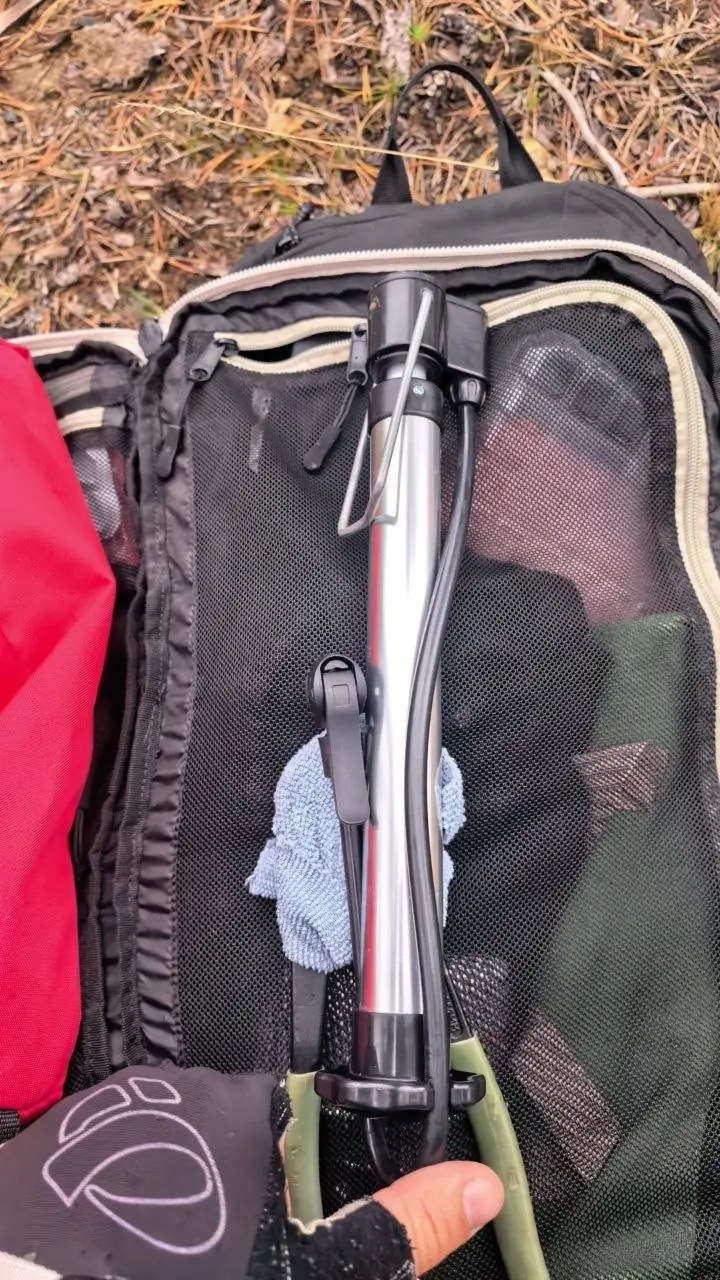
A compact hand pump is what you need. It mounts on the frame or goes in a backpack and inflates a tire in a couple of minutes of hand pumping.
When choosing, look at three things:
- Valve type. Most bikes in Russia have an AV valve (also Schrader, like on a car). Sports bikes have Presta. A good pump does both, with a reversible head.
- Hose. A flexible hose is more convenient than a rigid one: you can pump without shifting the body or bending the valve.
- Pressure gauge. Not essential, but it saves you from the habit of pumping 'by feel'.
Which tube you need
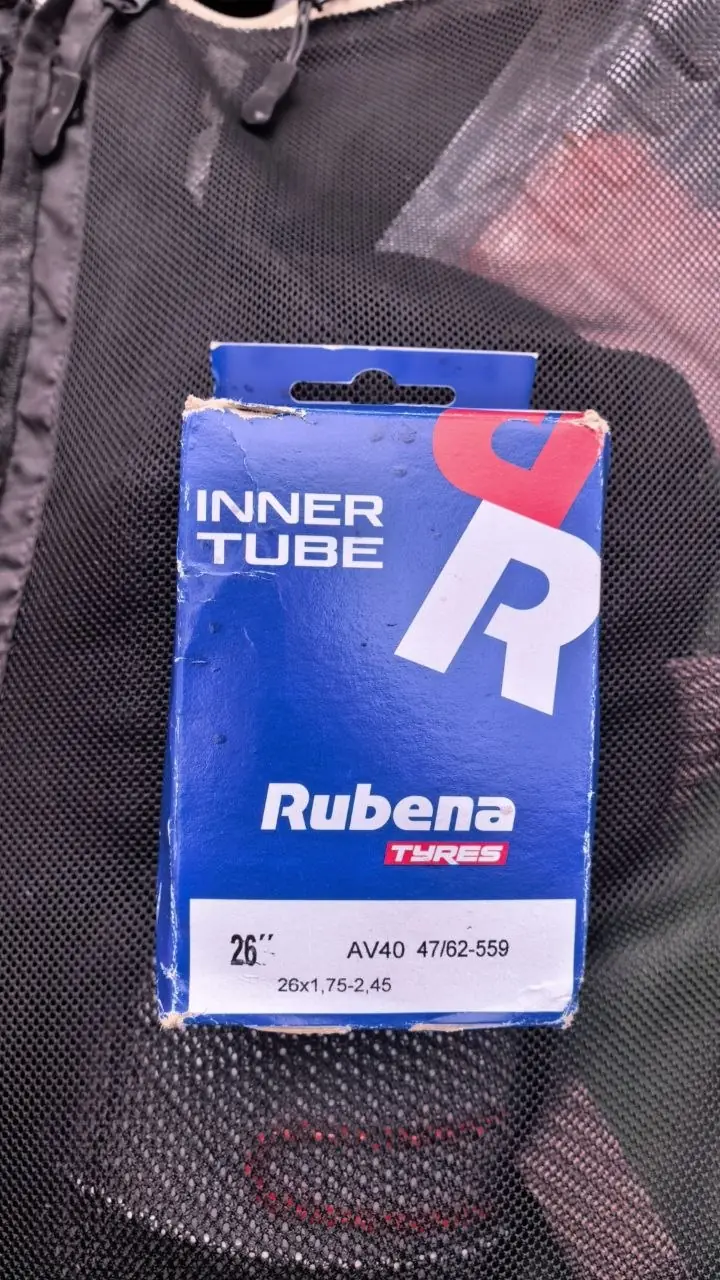
The tube size must match the tire. Look at the tire sidewall — it says something like 26×1.75–2.45 or 47/62-559. The first number is the diameter in inches, the second is the allowable width. A tube whose size falls within this range will fit.
The second characteristic is the valve: AV40 is a car valve 40 mm long, F/V or Presta is a sports valve. Take a tube with the same valve as yours, otherwise the pump won't fit it.
Third: when going on a trip, take a tube you've already checked — one that has been inflated and held. A new tube out of the box that has never been inflated might turn out to be defective exactly when you need it.
How to patch a puncture
If you don't have a spare or it's already used, a repair kit helps — tube patches.
- Find the puncture: inflate the tube and listen, or dip it in water — bubbles show the spot.
- Roughen the area around the puncture with the sandpaper from the repair kit.
- Apply a thin layer of glue, let it dry until tacky.
- Press the patch on and hold according to the instructions — usually a few minutes.
- Inflate and check that it holds.
Tire removal and installation are done by hand. A key or tire levers are needed if the tire fits tightly; on flat ground it's easier to do this together or with a lever.
What else is nearby
Chain tool. It's not for the tube but for the chain: if the chain breaks, you can't reconnect it without a chain tool. It's also useful for shortening the chain on the spot.
Bike multi-tool. Hex keys, screwdrivers and a chain tool in one piece of metal. Instead of a couple of wrenches — it doesn't replace an adjustable wrench, but covers almost all small fasteners.
How much it costs
A compact pump — from 1,000 rubles, a tube — from 300, a repair kit with patches — from 200. A kit of these three things is cheaper than one taxi ride with a bike, and it's exactly what covers the most common breakdown.
Frequently asked questions
A compact hand pump with a flexible hose and a head for both valve types — AV and Presta. A floor pump inflates faster, but you don't take it on a day ride.
By tire size: the sidewall says something like 26×1.75–2.45 or 47/62-559. The tube must fall within this range, and the valve must match yours (AV or Presta).
A repair kit for patching a puncture: patches, glue and sandpaper. They let you fix the tube in the field and get home if you no longer have a spare.
You can, but then a puncture means the end of the route if there's no transport nearby. A tube blowout on a root happens suddenly and can't be repaired on the spot.
Related
- What to take on a bike trip — Big article: 15 things proven by breakdowns
- Transporting a bike on a commuter train — When it's free, when it's paid and how to carry it comfortably
- Bike repair kit — Adjustable wrench, chain tool and what actually breaks
- Bike first aid kit — What to put in a travel first aid kit and how to treat scrapes
- Bike lock — Chain or cable: what protects and why convenience matters more than weight
- Bike light — How to choose a light to see the road and be seen
- Bike gloves — Why the palms take the impact and how to choose the size
- What to take on a 1-day hike — A short list without extra weight
Frequently asked questions
Which pump is needed for a bike?
A compact hand pump with a flexible hose and a head for both valve types — AV and Presta. A floor pump inflates faster, but you don't take it on a day ride.
Which tube to buy?
By tire size: the sidewall says something like 26×1.75–2.45 or 47/62-559. The tube must fall within this range, and the valve must match yours (AV or Presta).
What are tube patches?
A repair kit for patching a puncture: patches, glue and sandpaper. They let you fix the tube in the field and get home if you no longer have a spare.
Can you ride without a spare tube?
You can, but then a puncture means the end of the route if there's no transport nearby. A tube blowout on a root happens suddenly and can't be repaired on the spot.