Bike First-Aid Kit: What to Pack
The first-aid kit is the part of your gear you take the longest to assemble, because you usually don't remember why you need it. Until you do.
What happens when you fall off a bike
Let's take the most common scenario. Speed 15 km/h, the wheel slips on sand, you fall. Your head is usually fine: you manage to put your hands out. But your hands are exactly what suffers — the body instinctively throws them forward, and your palms take the whole impact. It's built into us: sacrifice the hands but save the organs.
The result is road rash: a patch of skin sliced off a couple of millimetres deep. The area is small, the pain is hellish: a few square centimetres of skin are scraped off, it bleeds and stings with every turn of the handlebars. You can't ride with it — not because it's dangerous, but because it's unbearable.
And it's treated on the spot, with simple things.
Minimum contents
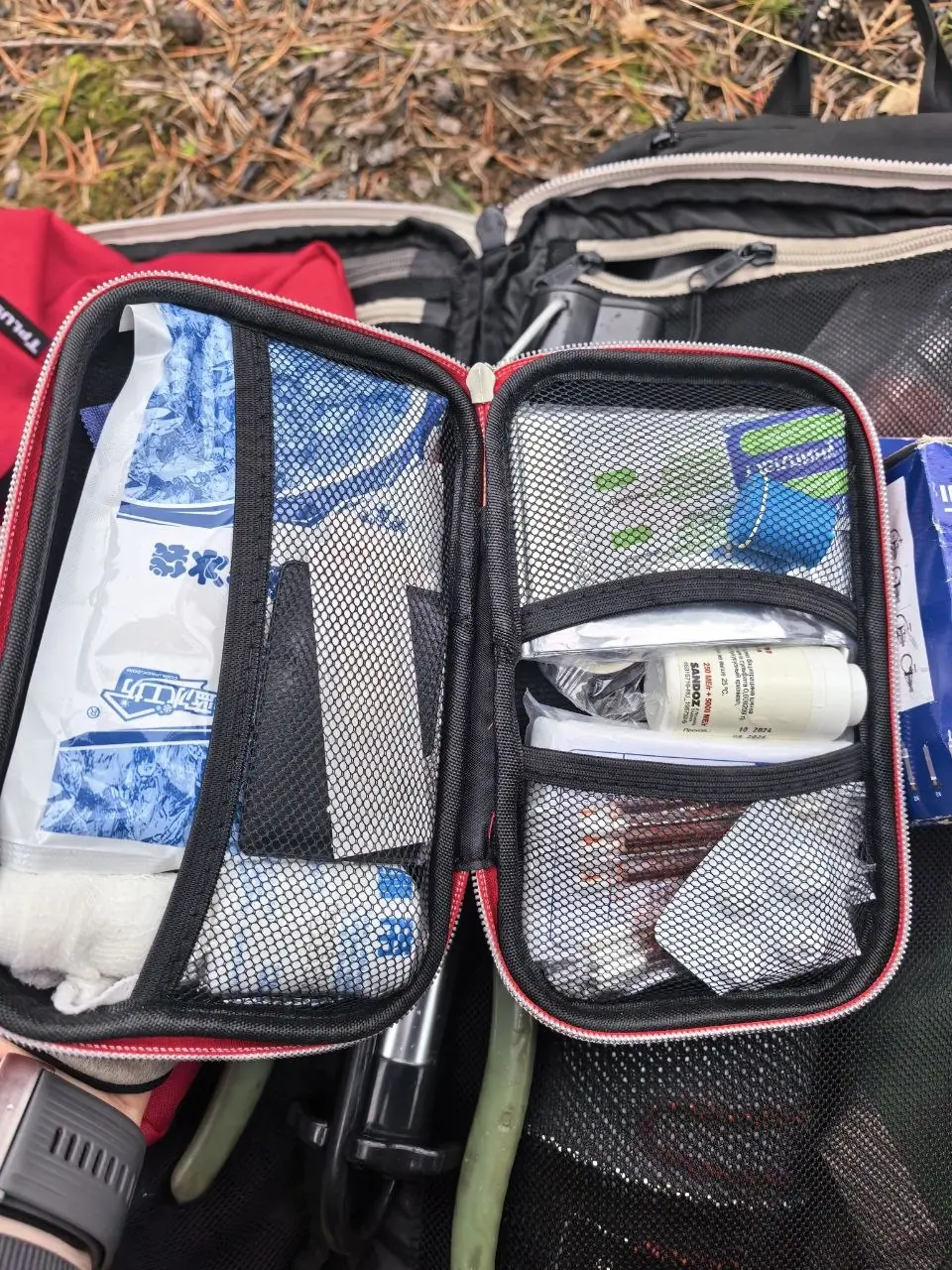
Plasters — they run out fastest. Take both regular and large ones: a small one won't cover a scraped palm.
A bandage or elastic bandage — if the wound is bigger than a plaster can cover, or if you need to immobilise a joint.
Antiseptic. Baneocin or an equivalent — an antibiotic ointment for abrasions. Plus iodine sticks: you snap one and iodine appears, so you can treat a wound without a bottle that will inevitably leak in your backpack.
Painkillers. Not for injuries, but for the case of "I've ridden far and now I have a headache". You want to ride back comfortably, not on willpower.
Wipes — to wipe your hands before touching the wound. There's nowhere in the forest to find a clean cloth.
What you don't need in a hiking first-aid kit
Stretchers, splints, tourniquets, a full tourist kit. On a day trip along forest roads that's extra weight: people are always closer than you think, and a heavy first-aid kit will stay at home.
Medicines "for all occasions" without understanding what to do with them. A first-aid kit only works if you know what's where.
How to pack it
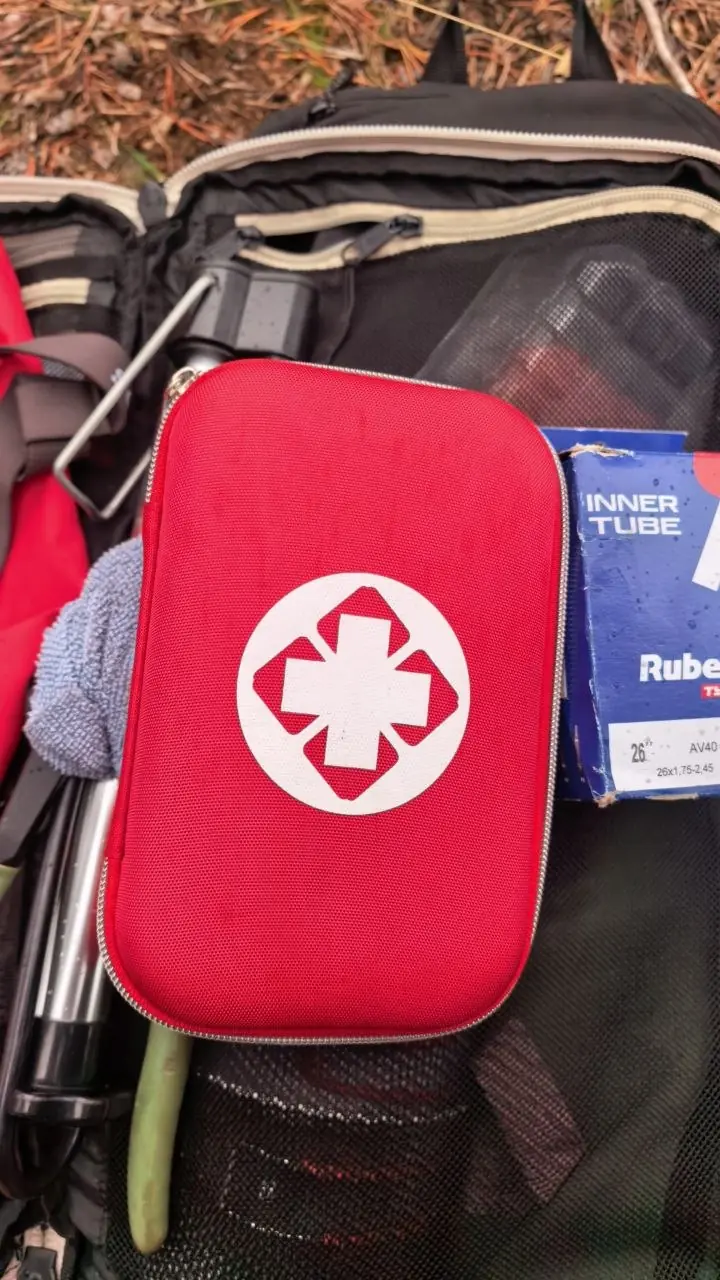
Pack the first-aid kit so it's visible and easy to reach: in a mesh organizer or a separate bright pouch that sits on top of your backpack. A bike first-aid kit isn't needed "somewhere at the bottom" — it's needed ten seconds after a fall.
Keep it tidy inside: plasters separate, bandages separate, antiseptic in a pocket. When your palm is bleeding, there's no time to sort through a pile of packets.
A car first-aid kit and a hiking one are different things
A car first-aid kit is assembled for different injuries: fractures, burns, bleeding. On a bike trip the kit is different — abrasions and bruises dominate. So you can't just "take the car one": you need your own, small and precise.
How much it costs
The minimum contents — plasters, bandage, antiseptic, iodine sticks and painkillers — comes to about 500–800 roubles if you buy them separately. After that the contents adapt to you: some people always have an allergy remedy in their kit, others a stomach one.
Frequently asked questions
Plasters of various sizes, a bandage, an antiseptic (ointment or iodine sticks), painkillers and wipes. That's enough for abrasions and bruises on a day trip.
Rinse, treat with an antiseptic and cover with a plaster or bandage. Road rash is small in area but hurts a lot — and it's treated on the spot without seeing a doctor.
Splints, tourniquets and large kits — on a day trip that's extra weight. You also shouldn't carry medicines you don't know how to use.
The minimum contents cost around 500–800 roubles when bought separately.
Related
- What to take on a bike trip — Big article: 15 things tested by breakdowns
- Carrying a bike on a commuter train — When it's free, when it's paid and how to carry it comfortably
- Pump, inner tube and patches — The kit that covers the most common breakdown
- Bike repair kit — Adjustable wrench, chain tool and what actually breaks
- Bike lock — Chain or cable: what protects and why convenience matters more than weight
- Bike light — How to choose a light to see the road and be seen
- Cycling gloves — Why the palms take the impact and how to choose the size
- What to take on a 1-day hike — A short list without extra weight
Frequently asked questions
What should be in a bike first-aid kit?
Plasters of various sizes, a bandage, an antiseptic (ointment or iodine sticks), painkillers and wipes. That's enough for abrasions and bruises on a day trip.
How do you treat road rash?
Rinse, treat with an antiseptic and cover with a plaster or bandage. Road rash is small in area but hurts a lot — and it's treated on the spot without seeing a doctor.
What can you leave out of a first-aid kit for a bike trip?
Splints, tourniquets and large kits — on a day trip that's extra weight. You also shouldn't carry medicines you don't know how to use.
How much does it cost to assemble a travel first-aid kit?
The minimum contents cost around 500–800 roubles when bought separately.