Taking a Bicycle on a Commuter Train
The commuter train is the main transport for a bike trip: you get to the right station, ride out into the forest, and don't waste energy on asphalt across the whole city. But it is precisely a bicycle on a commuter train that most often becomes a cause of conflict: it gets in someone's way, someone demands a surcharge, someone simply won't let you on.
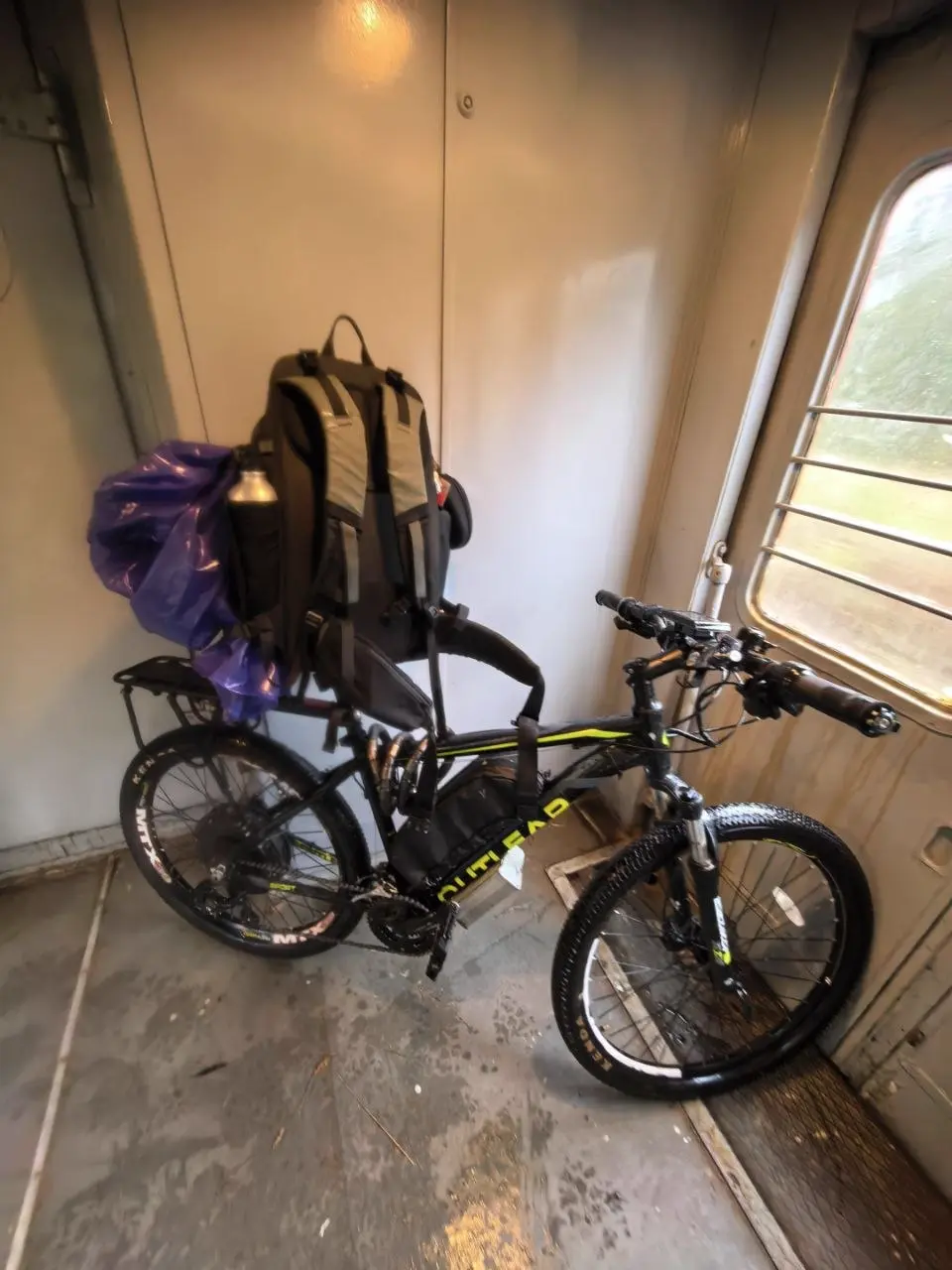
Let's go through it step by step, so the trip starts from the right station and not from a conversation with the ticket inspector.
When Carriage Is Free
According to suburban transport rules, a bicycle is carried free of charge during off-peak hours. Usually this is the morning after the morning rush and late evening: a time when the train is half-empty.
An important detail that trips people up: free carriage does not mean without a ticket. A ticket for the bicycle is still taken at the cash desk, it's just zero-fare or issued as a separate line. If you board without it, formally you are without a baggage ticket, and the inspector's question will be unpleasant.
Current hours and tariffs change — it's worth checking on the carrier's website before the trip. The general logic is this: peak — paid and inconvenient, off-peak — free and easy.
When It's Paid and What It Looks Like
During peak hours, the bicycle travels in the vestibule for a separate fee. The vestibule is not infinite, and the rule is simple: one vestibule — one bicycle. If there are two cyclists, a conversation begins that usually resolves in favor of whoever took the spot first.
Hence the practical conclusion: if you're traveling with a bicycle during rush hour, it's better to be at the door before others — a spot in the vestibule is claimed with your feet, not with a ticket.
Why Off-Peak Is Better Not Only Because of Money
An off-peak train gives three things that are more important than price.
First: you don't have to hold the bicycle up. In an empty carriage it stands calmly, and you don't waste energy keeping it upright on turns.
Second: no one gives you dirty looks. Carrying a bicycle always means a bit of space and a bit of dirt from the wheels. In a half-empty carriage, this is nobody's business.
Third: you can sit by the window and ride. The difference between "arrived" and "arrived exhausted" is felt on the very first kilometer in the forest.
How to Ride Comfortably
Remove anything that sticks out. Before entering the carriage, take off the water bottle, and if you have one, the dry bag from the handlebars: they catch on everything.
Keep the bicycle vertical, pressed against you, rather than standing it on a wheel in the aisle. This way it takes up less space and doesn't roll away.
Don't roll the bicycle out first at your station. While the train hasn't stopped, you stand in the vestibule by the door with the bicycle — and exit immediately, without delaying anyone.
Carry clothes and backpack on yourself, don't hang them on the handlebars: this makes the bicycle more stable and it doesn't catch on anything.
How to Know It's Your Station
A commuter train into the forest is not a terminal station with a rail hub, but a platform with a staircase and an embankment. The exit with a bicycle almost always looks the same: a few meters of asphalt, steps, and immediately dirt. If the bicycle is heavy, the steps are the most unpleasant part of the whole trip, so it's better to put on your backpack before leaving the carriage, not on the platform.
In Short
The rule is simple: off-peak — free, but a ticket from the cash desk; peak — vestibule and surcharge. Off-peak is calmer and physically easier, and the bicycle doesn't turn into a problem for the carriage. And then the forest begins.
Frequently Asked Questions
During off-peak hours carriage is free, but a ticket for the bicycle is still taken at the cash desk. During peak hours the bicycle is carried in the vestibule for a separate fee — check the tariff with the carrier.
The rule is one bicycle per vestibule. Two bicycles in one vestibule create a problem both for passengers and for exiting at the station.
During off-peak hours: carriage is free, the carriage is spacious, the bicycle doesn't need to be held up, and no one gets annoyed by dirty wheels.
No. The bicycle is carried whole in the vestibule. You should only remove the water bottle and the bag from the handlebars — they get in the way and catch on things.
Related
- What to Take on a Bike Trip — A big article: 15 things tested by breakdowns
- Pump, Spare Tube, and Patches — A kit that covers the most common breakdown
- Bicycle Repair Kit — An adjustable wrench, chain tool, and what actually breaks
- Bike First-Aid Kit — What to put in a travel first-aid kit and how to treat scrapes
- Bike Lock — Chain or cable: what protects and why convenience matters more than weight
- Bike Light — How to choose a light to see the road and be seen
- Bike Gloves — Why the palms take the impact and how to choose the size
- What to Take on a 1-Day Hike — A short list without extra weight
Frequently asked questions
How much does it cost to take a bicycle on a commuter train?
During off-peak hours carriage is free, but a ticket for the bicycle is still taken at the cash desk. During peak hours the bicycle is carried in the vestibule for a separate fee — check the tariff with the carrier.
Can two bicycles be carried in one vestibule?
The rule is one bicycle per vestibule. Two bicycles in one vestibule create a problem both for passengers and for exiting at the station.
When is the best time to travel with a bicycle?
During off-peak hours: carriage is free, the carriage is spacious, the bicycle doesn't need to be held up, and no one gets annoyed by dirty wheels.
Do I need to remove the wheel or disassemble the bicycle?
No. The bicycle is carried whole in the vestibule. You should only remove the water bottle and the bag from the handlebars — they get in the way and catch on things.