Top 5 places in Sablino worth coming for
Introduction
Sablino is not just a point on the map of Leningrad Region, but a real geological reserve hidden an hour's drive from noisy St Petersburg. Here, among pine forests and winding rivers, time flows differently: the cliffs remember ancient seas, and in the darkness of man-made caves the spirit of merchant adventures still lingers. This is a place where in one day you can go underground, stand at the foot of waterfalls that are contemporaries of Niagara, and walk along a trail laid along canyons. Sablino is an ideal option for those who want to escape the city bustle without going far, and get a dose of fresh air, history and legends. Everyone will find something of their own here: an adventure seeker, a photographer, and simply a traveler tired of asphalt.
1. Sablino caves — an underground museum
The Sablino caves are the heart of the reserve and perhaps its most mysterious part. Unlike natural karst cavities, these are man-made labyrinths that appeared in the 19th century. At that time, white quartz sand was mined here for the glass industry. Workers carved entire halls in the sandstone, leaving behind bizarre columns and arches. Today, the Left Bank cave is a museum underground, where you can see traces of old tools, underground lakes with crystal clear water, and even bats that have taken a liking to these cool halls.
The tour lasts about 45 minutes, and during this time you will have time to imbibe the gloomy romance of the dungeon. The temperature here stays at +8 degrees all year round, so even in summer heat it is worth taking a warm sweater. You can only get inside as part of an organized group and by prior arrangement — this is important for the preservation of the fragile vaults. The price ranges from 550 to 1250 rubles depending on the chosen route and level of difficulty. This is not just a walk, but a real journey into the depths of history, where every rustle echoes, and flashlights snatch amazing patterns on the walls from the darkness.
2. Sablinsky waterfall — a 'living' waterfall
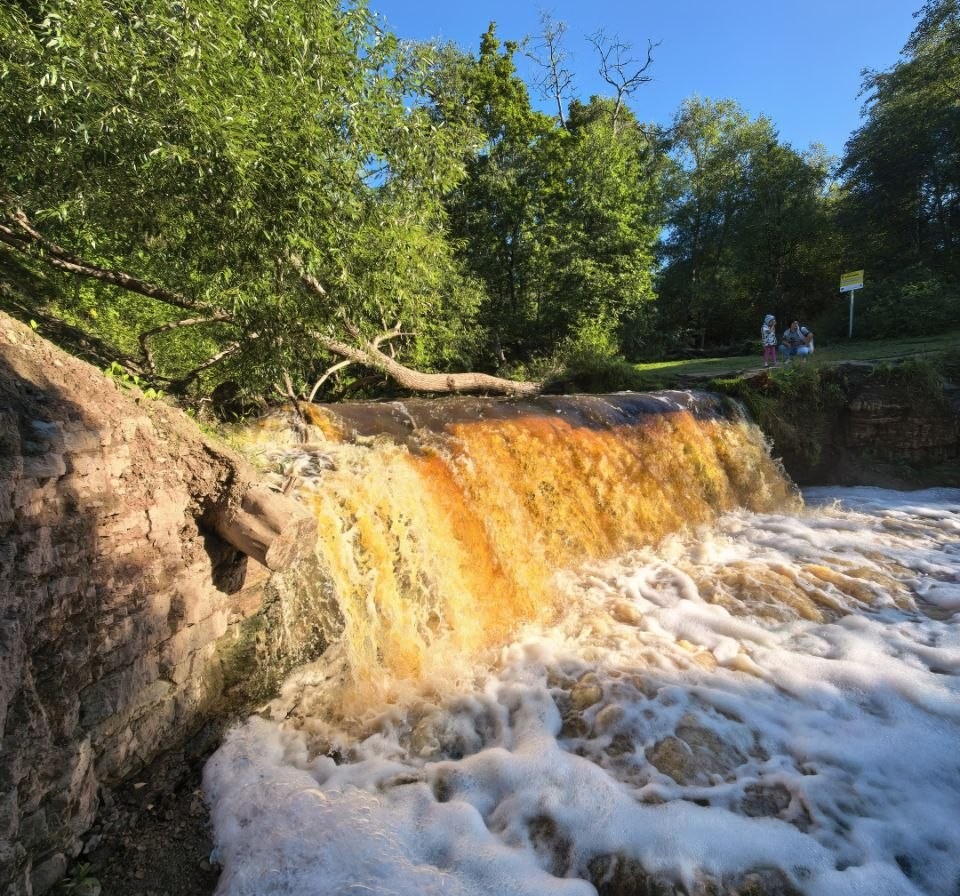
The Sablinsky waterfall is perhaps the most 'inconstant' object of the reserve. Located on the Sablinka River, it does not have a fixed height. The figures in guidebooks (about 2.3 meters) are only an average value. Depending on the season and precipitation, the waterfall either shrinks to a thin stream or turns into a powerful flow thundering down from the sandstone ledge. It is this variability that locals call the 'living' character of the waterfall. In winter, it often freezes, turning into a bizarre ice sculpture that shimmers in the sun.
It is best viewed from the wooden observation deck, which is equipped a little downstream. From here there is an excellent view of the cascade and of how water wears away the sandstone, creating intricate shapes. Entry to the waterfall is free, so people often come here just to sit on the bank, listen to the sound of water and have a picnic. This is a great place for meditation and beautiful photos, especially at sunset, when the sun's rays illuminate the water dust, creating an effect of light haze.
3. Tosnensky waterfall — a contemporary of Niagara
If the Sablinsky waterfall is a 'baby', then the Tosnensky is a real veteran. Its age is estimated at about 11 thousand years, which makes it a contemporary of the famous Niagara. It was formed as a result of glacier melting, when huge masses of water made their way through the sandstone. The width of the waterfall reaches 30 meters, which is impressive, although the height is not great — only about 2 meters. Because of this, it looks more like a powerful, wide threshold that blocks the Tosna River.
Standing on the observation deck, it is easy to imagine what power this river had thousands of years ago. The water here does not fall vertically, but rolls over the ledge, creating a solid wall of foam and spray. The roar of the waterfall can be heard long before you approach it. This place is a real natural monument, and access to it is absolutely free. Near the waterfall there is a cozy clearing where you can relax, as well as a small ecological trail leading along the bank.
4. Canyons — sandstone cliffs
The main geological wonder of Sablino is the canyons of the Sablinka and Tosna rivers. They are not as deep and harsh as, for example, the canyons of North America, but no less impressive. High cliffs of red-brown sandstone, whose age exceeds 500 million years, hang over the water, creating the feeling that you have found yourself in another era. Scientists call this phenomenon 'headward erosion': water constantly washes away the base of the cliffs, causing the upper layers of rock to collapse, and the canyon slowly 'retreats' backward.
Walking along the top of the cliffs, you can see unique geological sections where layers of ancient sandstones, clays and even fossils are visible. In some places the bank is literally cut by ravines that form bizarre labyrinths. Photos here turn out incredibly atmospheric: the contrast of the red rock, emerald water and green pines. The canyons are the best way to understand how the landscape of Leningrad Region was formed, and to feel like a small particle in the endless flow of geological time.
5. Sablino trail — route and the Tsar Tree
The Sablino trail connects all the main attractions — a walking route about 3 kilometers long. This is not just a path, but a well-thought-out ecological route, marked according to the international classification as SAC T1 (simple, accessible for beginners). A walking pace will take you no more than 1.5–2 hours including stops. The trail goes along the cliffs, descends to the water and passes through picturesque forests, allowing you to see all the key points of the reserve without unnecessary haste.
The main 'highlight' of the route is the so-called 'Tsar Tree'. This is a huge oak, whose age, according to experts, exceeds several hundred years. Its mighty branches spread over tens of meters, and the trunk is so thick that three adults could not encircle it. The place is considered energetically strong, and tourists always stop here to take photos and make a wish. In addition, on the trail you can see a rare sight — nests of sand martins, which dig their burrows right in the sandy cliffs. Hundreds of small holes in the wall look like the honeycombs of a giant hive — this is a fascinating
Source of facts: official website sablino.net, tel. +7 (952) 270-48-03.
📸 Photos of Sablino — the whole route
119 shots from the entire route: caves, canyons, trail, waterfall, commuter train. Taken on location.